I haven't really ventured onto the patch much, but with a few migrants starting to pass through Paston Cliffs seemed a good place to visit after waking early on Thursday (23rd).
Arriving at 6.15am the site was very quiet, just a few Dunnock and the resident Linnet viable on exiting the car. I had walked only a few yards and a large spot of rain landed on my head. I had a quick scan of the scrub by the car and spent a few minutes rooting out a juv. Whitethroat before the shower forced me back into the car. I re positioned the car had 10 minutes sea watching while the shower quickly blew through, my reward a single distant Gannet and unidentified small wader.
Walking towards the Gas Terminal everything was rather subdued, with the highlight being a very smart Greenfinch unusual for the site. A few Swallow drifted east seemingly with purpose, and a Kestrel hoovered over the cliff edge. Back near the car a female Sparrowhawk cut along the hedge boardering the path coming within a few feet, and near the holiday chalets a male was also perched up (the reason for a lack of bird life?). A secretive warbler could not be teased out of the Blackthorn and I soon found myself back at the car, minus any early migrants. A further 15 minutes of sea watching gave up my first Manx Shearwater of the year, two Auks both almost certainly Guillemot and few distant Tern, a mixture of Sandwich and probably Common. With little passing within reasonable distance of the shore I headed home.
Monday, 27 August 2018

Wednesday, 15 August 2018
A Summer Update
Since my last update I haven't been out birding much with only a few local walks between the blistering sun, a family wedding in Wales and fitting a new kitchen.
During June a Cuckoo seen at Coltishall on the way to work on 5th has been my only Cuckoo sighting of the year until a Juv. bird at Potter Heigham on 7th August. Also in June I stumbled across a Honey Buzzard near Stalham on the 10th. While in Wales I caught up with a Wood Warbler (15th June) after missing the Mousehold Heath bird earlier in the year.
July was written off with the blistering heat, although a boat trip on Malthouse Broad did allow Agnes so close views of Terns and young Great Crested Grebe she really enjoyed. Most days while going to work I have seen Black Redstart in Norwich city center with at least two broods appearing to have fledged.
August brought a bit of a rest bite from the blistering heat, but also a delivery van containing a new kitchen on the 1st. Installing the kitchen is almost complete, but a family bereavement has also left me with little time. Being stuck at home did have one highlight a Spotted Flycatcher briefly in the garden on the 5th. I have also noted more butterflies and dragonflies in the garden than previous years, with Banded Damoselle and Red-eyed Damselfly new for the garden list. The moth trap hasn't had many outing after getting boxed at the back of the garage behind boxes of kitchen parts. In the last few days I have found Elephant Hawk Moth and Lime Hawk Moth caterpillars in the garden.
The allotment has been parched so I haven't been there as often as I would like, abandoning many of my crops due to the lack of water on site. The Badgers are still very active in the area with young seen on the trail cam, Hornets have started nesting in the old shed, Lesser Whitethroat have bred and I have seen Slow Worm and Grass Snake.
On the 7th August I put the kitchen aside for a few hours and arrived at Potter Heigham at 7am before any heat haze. Walking the river bank I kind birder directed my further along with directions to the Spotted Crake, I soon found both birds present. 5+ Wood Sandpiper, 2 Green Sandpiper, 1 Common Sandpiper and 7+ Ruff were the wader highlights. Juvenile birds seemed to be flitting everywhere among the reeds, with Sedge, Reed and Grasshopper Warbler all seen. A Sedge Warbler was also seen feeding a fully grown juv. Cuckoo. Also worth note were the 20+ Little Grebes and 5+ Gargany on site.

During June a Cuckoo seen at Coltishall on the way to work on 5th has been my only Cuckoo sighting of the year until a Juv. bird at Potter Heigham on 7th August. Also in June I stumbled across a Honey Buzzard near Stalham on the 10th. While in Wales I caught up with a Wood Warbler (15th June) after missing the Mousehold Heath bird earlier in the year.
July was written off with the blistering heat, although a boat trip on Malthouse Broad did allow Agnes so close views of Terns and young Great Crested Grebe she really enjoyed. Most days while going to work I have seen Black Redstart in Norwich city center with at least two broods appearing to have fledged.
August brought a bit of a rest bite from the blistering heat, but also a delivery van containing a new kitchen on the 1st. Installing the kitchen is almost complete, but a family bereavement has also left me with little time. Being stuck at home did have one highlight a Spotted Flycatcher briefly in the garden on the 5th. I have also noted more butterflies and dragonflies in the garden than previous years, with Banded Damoselle and Red-eyed Damselfly new for the garden list. The moth trap hasn't had many outing after getting boxed at the back of the garage behind boxes of kitchen parts. In the last few days I have found Elephant Hawk Moth and Lime Hawk Moth caterpillars in the garden.
The allotment has been parched so I haven't been there as often as I would like, abandoning many of my crops due to the lack of water on site. The Badgers are still very active in the area with young seen on the trail cam, Hornets have started nesting in the old shed, Lesser Whitethroat have bred and I have seen Slow Worm and Grass Snake.
On the 7th August I put the kitchen aside for a few hours and arrived at Potter Heigham at 7am before any heat haze. Walking the river bank I kind birder directed my further along with directions to the Spotted Crake, I soon found both birds present. 5+ Wood Sandpiper, 2 Green Sandpiper, 1 Common Sandpiper and 7+ Ruff were the wader highlights. Juvenile birds seemed to be flitting everywhere among the reeds, with Sedge, Reed and Grasshopper Warbler all seen. A Sedge Warbler was also seen feeding a fully grown juv. Cuckoo. Also worth note were the 20+ Little Grebes and 5+ Gargany on site.

Thursday, 31 May 2018
Late May Update
Since my last last update on the 8th I haven't been out birding much in Norfolk, the main reason being a weeks family holiday to Cornwall. It looks like i missed out on the influx of Black Tern and a few later migrants but I may get a chance to see a few if they linger before heading to Wales for a few days and a family wedding.
With the influx of Black Redstart on the coast it wasn't a massive surprise to find one singing in Norwich City Center. What was a surprise was i was sitting on the canteen terrace at work when I heard and then saw the Black Redstart in 10th. In fact at least two and probably 3 males have been singing in the city over the last month, and before seeing the Black Redstart at John Lewis (work), I had looked for another just of Rose Lane that morning. Since then the 'John Lewis' bird I have seen 3 times and heard most days until 16th, also heard the 'Rose Lane' bird on 11th and since returning from Cornwall see the 'Castle Meadow' bird 3 times.
Continuing on the bird watching on route to work note on the 11th I heard a singing Cetti's Warbler near to Cow Tower and also watched the Peregrine hunting over the playing fields. Lost of large fish, bream? were also feeding under the willows along Riverside walk. Today 31st a Yellow-legged Gull was another surprise being near New Mills Yard by the sluices, my 100th bird seen on route to work.
While in Cornwall we were blessed with delightful weather and although not a bird watching trip, and with no rare birds arriving while i was there I was lucky enough to catch up with a few special birds. The biggest piece of luck came while travelling down to Cornwall. The (out of date) Sat Nav plotted us a bizarre route around Salisbury Plain, after I asked it to avoid a particular road closure (it turns out the road wasn't even closed), and while on this detour of small lanes that we chanced upon a Great Bustard, although obviously part of the reintroduction scheme, a bird I never imagined we would see.
Staying not far from Truro we visited The Lizard on the 18th and saw my only 'target' bird of the trip a Chough, we also saw two Turtle Dove for the year list as well as Razorbill, Shag and other resident birds. On the 23rd I added my first new 'Pub List Bird' for a few years with a Whimbrel from The Ship Inn in Devoran. (I must try harder to visit a few pubs while on my bird watching trips). A singing Wood Warbler withing the gated holiday complex we stayed at on the 24th was very unexpected. After missing the Mousehold bird I wasn't expecting to catch up with one until my South Wales visit.

On Tuesday 29th after visiting the opticians and waiting in for a delivery I found myself with a few hours to kill so decided on a trip to Potter Heigham Marshes (I also bought a new strimmer in Latham's). It was rather blustery but still I found lots of waders many with chicks and other water fowl on the pools. Pick of the bunch were two Curlew Sandpiper, two Common Sandpiper and a Greenshank, c30Black-tailed Godwit, 9 Dunlin and 1 Grey Plover were also of note. A Great White Egret flew over and a pair of Pochard with 2 chicks were an unusual sight.
With the influx of Black Redstart on the coast it wasn't a massive surprise to find one singing in Norwich City Center. What was a surprise was i was sitting on the canteen terrace at work when I heard and then saw the Black Redstart in 10th. In fact at least two and probably 3 males have been singing in the city over the last month, and before seeing the Black Redstart at John Lewis (work), I had looked for another just of Rose Lane that morning. Since then the 'John Lewis' bird I have seen 3 times and heard most days until 16th, also heard the 'Rose Lane' bird on 11th and since returning from Cornwall see the 'Castle Meadow' bird 3 times.
Continuing on the bird watching on route to work note on the 11th I heard a singing Cetti's Warbler near to Cow Tower and also watched the Peregrine hunting over the playing fields. Lost of large fish, bream? were also feeding under the willows along Riverside walk. Today 31st a Yellow-legged Gull was another surprise being near New Mills Yard by the sluices, my 100th bird seen on route to work.
While in Cornwall we were blessed with delightful weather and although not a bird watching trip, and with no rare birds arriving while i was there I was lucky enough to catch up with a few special birds. The biggest piece of luck came while travelling down to Cornwall. The (out of date) Sat Nav plotted us a bizarre route around Salisbury Plain, after I asked it to avoid a particular road closure (it turns out the road wasn't even closed), and while on this detour of small lanes that we chanced upon a Great Bustard, although obviously part of the reintroduction scheme, a bird I never imagined we would see.
Staying not far from Truro we visited The Lizard on the 18th and saw my only 'target' bird of the trip a Chough, we also saw two Turtle Dove for the year list as well as Razorbill, Shag and other resident birds. On the 23rd I added my first new 'Pub List Bird' for a few years with a Whimbrel from The Ship Inn in Devoran. (I must try harder to visit a few pubs while on my bird watching trips). A singing Wood Warbler withing the gated holiday complex we stayed at on the 24th was very unexpected. After missing the Mousehold bird I wasn't expecting to catch up with one until my South Wales visit.

On Tuesday 29th after visiting the opticians and waiting in for a delivery I found myself with a few hours to kill so decided on a trip to Potter Heigham Marshes (I also bought a new strimmer in Latham's). It was rather blustery but still I found lots of waders many with chicks and other water fowl on the pools. Pick of the bunch were two Curlew Sandpiper, two Common Sandpiper and a Greenshank, c30Black-tailed Godwit, 9 Dunlin and 1 Grey Plover were also of note. A Great White Egret flew over and a pair of Pochard with 2 chicks were an unusual sight.
Tuesday, 8 May 2018
Taking a Dip on a Hot Day
Today (Tues 8th) after spending most of Bank Holiday Monday replacing a couple of rotten sections of our conservatory I finally had a list of jobs that could at least wait half a day, so I decided a trip to Cley NWT was in order to look for the Purple Heron, not a 'lifer' but a Norfolk tick none the less.
Agnes and I left after an early breakfast as I didn't want to be out in the full heat with her. We first stopped at Salthouse Heath to look for Nightingale, although not the ideal time of day after a short wander around I located a single bird giving short often incomplete bursts of song. A Garden Warbler was also heard but not located.
Moving onto Cley NWT, from the bottom of Old Woman Lane I could see a group of birders on the West Bank all looking in different directions, I guessed the Purple Heron wasn't showing. Agnes and I therefore first tried the hide cluster. Reed and Sedge Warbler serenaded our walk, and after greeting the birders in the hide Agnes sat down to watch her 'birdies'. From Daukes Hide Avocet, Godwit and a summer plumage Ruff came very close to the hide exciting Agnes, but I mistakenly it appeared had swapped my camera bag for her change bag! Two Little Tern were my first of the year and a Sandwich Tern briefly stopped in. I checked the log book and noted that a Spotted Redshank was apparently still around so had a second check of the back of the scrape with the scope. A Common Sandpiper wandered the margins and two Little Ringed Plover were nice to see as always, I then found the Spotted Redshank, a bonus bird for late spring. We spent a short while in the Avocet Hide scanning Cricket Marsh for the Purple Heron but without luck. The Common Sandpiper did however come within feet of the hide and some Avocet displayed almost as close. By the Warden's House the call of a Cetti's Warbler perplexed Agnes, I could see the bird but she couldn't. While listening to its calls a Swift wheeled away overhead another new bird for the year. Parking up on Beach Road we joined the small group looking for the Purple Heron, it hadn't been seen all morning. We waited about 25 minutes with the only birds of note a couple of Wheatear.
It was only just after 10.00 we stopped on Kelling Heath to look for the resident Dartford Warbler. Linnet seemed to be the bird of the moment, seemingly singing from every bush, being joined by the occasional burst of Whitethroat. We found a couple of Common Lizards one of which kept Agnes amused as it popped its head in and out from a tussock of grass. I only saw one Adder, which although not approached closely reared up and hissed before slithering away. At least one Woodlark was heard singing but not seen, and a couple of Blackcap were in the Silver Birch. I had given up on Dartford Warbler when walking back past an area already checked, I heard the mechanical song from a stand of Gorse, rounding the corner I briefly saw the bird, before it saw me and dropped down from its perch. Back in the car park a Garden Warbler was calling in the scrub, after a few minutes and changes of viewing angle, eventually I could see the source. Although I was feeling the heat I think Agnes would have wandered the Heath all day but I needed to get back to those not so important jobs at home.

Despite dipping on the target bird of the trip and at times the heat, it proved a worthwhile morning out which I think we both thoughtfully enjoyed. At some point Agnes is sure to rebel or if not become a bird watching maestro, either way I lovely she wants to share my passion.
On Sunday (6th) after work I called into Mousehold Heath to look for a singing Wood Warbler, still in shirt and trousers (there's nothing wrong with formal birding). Upon arrival I met Ricky and a few other local birders, who informed me I had missed the bird by 5 minutes and it was being a bit illusive. I spent the next 45 minutes wandering the area without luck, before duties at home meant I had to head off. It was great to catch up with a couple of birders I've not seen for a while even if I missed the bird. After I left the bird was eventually found, having relocated across the road closer to the pitch and putt.
Agnes and I left after an early breakfast as I didn't want to be out in the full heat with her. We first stopped at Salthouse Heath to look for Nightingale, although not the ideal time of day after a short wander around I located a single bird giving short often incomplete bursts of song. A Garden Warbler was also heard but not located.
Moving onto Cley NWT, from the bottom of Old Woman Lane I could see a group of birders on the West Bank all looking in different directions, I guessed the Purple Heron wasn't showing. Agnes and I therefore first tried the hide cluster. Reed and Sedge Warbler serenaded our walk, and after greeting the birders in the hide Agnes sat down to watch her 'birdies'. From Daukes Hide Avocet, Godwit and a summer plumage Ruff came very close to the hide exciting Agnes, but I mistakenly it appeared had swapped my camera bag for her change bag! Two Little Tern were my first of the year and a Sandwich Tern briefly stopped in. I checked the log book and noted that a Spotted Redshank was apparently still around so had a second check of the back of the scrape with the scope. A Common Sandpiper wandered the margins and two Little Ringed Plover were nice to see as always, I then found the Spotted Redshank, a bonus bird for late spring. We spent a short while in the Avocet Hide scanning Cricket Marsh for the Purple Heron but without luck. The Common Sandpiper did however come within feet of the hide and some Avocet displayed almost as close. By the Warden's House the call of a Cetti's Warbler perplexed Agnes, I could see the bird but she couldn't. While listening to its calls a Swift wheeled away overhead another new bird for the year. Parking up on Beach Road we joined the small group looking for the Purple Heron, it hadn't been seen all morning. We waited about 25 minutes with the only birds of note a couple of Wheatear.
It was only just after 10.00 we stopped on Kelling Heath to look for the resident Dartford Warbler. Linnet seemed to be the bird of the moment, seemingly singing from every bush, being joined by the occasional burst of Whitethroat. We found a couple of Common Lizards one of which kept Agnes amused as it popped its head in and out from a tussock of grass. I only saw one Adder, which although not approached closely reared up and hissed before slithering away. At least one Woodlark was heard singing but not seen, and a couple of Blackcap were in the Silver Birch. I had given up on Dartford Warbler when walking back past an area already checked, I heard the mechanical song from a stand of Gorse, rounding the corner I briefly saw the bird, before it saw me and dropped down from its perch. Back in the car park a Garden Warbler was calling in the scrub, after a few minutes and changes of viewing angle, eventually I could see the source. Although I was feeling the heat I think Agnes would have wandered the Heath all day but I needed to get back to those not so important jobs at home.

Despite dipping on the target bird of the trip and at times the heat, it proved a worthwhile morning out which I think we both thoughtfully enjoyed. At some point Agnes is sure to rebel or if not become a bird watching maestro, either way I lovely she wants to share my passion.
On Sunday (6th) after work I called into Mousehold Heath to look for a singing Wood Warbler, still in shirt and trousers (there's nothing wrong with formal birding). Upon arrival I met Ricky and a few other local birders, who informed me I had missed the bird by 5 minutes and it was being a bit illusive. I spent the next 45 minutes wandering the area without luck, before duties at home meant I had to head off. It was great to catch up with a couple of birders I've not seen for a while even if I missed the bird. After I left the bird was eventually found, having relocated across the road closer to the pitch and putt.
Thursday, 3 May 2018
Winterton and Hickling NWT
Last Thursday (26th April) I headed off to Winterton hoping that the Pallid Harrier of previous days would still be present. On route a Yellow Wagtail was noted with the grazing sheep as we approached Waxham. I had decided to walk just the North Dunes, despite the south section often being more rewarding, I didn't think Agnes at 2 1/2 years would manage a full lap. Glancing out to sea at least 4 Common Tern were fishing, my first of the year and a couple of Wheatear where in the car park. Agnes enjoyed climbing the highest of the dunes in our attempts to find the Pallid Harrier, but without success. We did however see 25+ Wheatear, 2 Chiffchaff, a Willow Warbler and numerous Meadow Pipit and Linnet. The best moment of the day however was Agnes finding a Ring Ouzel. While I was inspecting a couple of very confiding Wheatear, Agnes shouted out 'Blackbird' and pointed to a male Ring Ouzel in the dune grasses. Walking back via the beach, a couple of Ringed Plover and the for mentioned Common Tern the only birds of note.
With rain forecast for the whole day on Wednesday (2nd), Agnes and I where at Paston Cliffs by 7.45am ahead of the rain. In the 45 minutes before the drizzle migrants finally seemed to be arriving. Getting out of the car I peered over the cliff edge checking the grassy slopes and scrub, expecting a Ring Ouzel, but not expecting the female Pied Flycatcher perched on the gorse. I thought this was a new patch bird but I had one here a few years back. Whitethoat have suddenly appeared in force with at least 5 singing on territory. 2 Chiffchaff were also calling including 1 individual that kept singing on the ground. Only 2 male Yellowhammer remain and the Linnet flock seems to have broken up with a few males spread out singing throughout the site. Despite the large numbers of Wheatear clearly finally on the move, we were walking back to the car before we saw 2 males perched on the remains of the chalets currently being upgraded. Also of not was the unusual sight of a Canada Goose on the sea.
Later in the afternoon, driving home after a trip to Sea Palling amusements a Hobby flew across the road close to Cart Gap in Happisburgh.
Today (3rd) we continued Agnes' birding education with a trip to Hickling NWT. Arriving around 8.30am we had the reserve to ourselves Agnes was very excited by the hides, whispering as she looked for birdies. Sedge Warbler and Reed Warbler were singing in good number, the former much easier to see. A Cetti's Warbler uncharacteristically sang out in the open and a Grasshopper Warbler was heard distantly. From the Observation Tower a few Tern could be seen out over the Broad, with at least 2 perched up closer being Arctic Tern. The Bittern Hide, like the Cadbury Hide only offered up the common waterfowl, but at least gave Agnes some practice separating ducks, geese and swans. Walking back along the raised bank a Hare slowly hopped along ahead of us, always remaining just out of photographing distance. A Bittern was briefly seen skimming the reed bed before again taking cover. After a picking a large toy dragonfly from the shop, a treat for walking the whole loop, we removed our muddied boots and headed home. Spending the rest of the day in the garden, a singing Whitethroat on the wasteland behind the house was a new garden tick.

With rain forecast for the whole day on Wednesday (2nd), Agnes and I where at Paston Cliffs by 7.45am ahead of the rain. In the 45 minutes before the drizzle migrants finally seemed to be arriving. Getting out of the car I peered over the cliff edge checking the grassy slopes and scrub, expecting a Ring Ouzel, but not expecting the female Pied Flycatcher perched on the gorse. I thought this was a new patch bird but I had one here a few years back. Whitethoat have suddenly appeared in force with at least 5 singing on territory. 2 Chiffchaff were also calling including 1 individual that kept singing on the ground. Only 2 male Yellowhammer remain and the Linnet flock seems to have broken up with a few males spread out singing throughout the site. Despite the large numbers of Wheatear clearly finally on the move, we were walking back to the car before we saw 2 males perched on the remains of the chalets currently being upgraded. Also of not was the unusual sight of a Canada Goose on the sea.
Later in the afternoon, driving home after a trip to Sea Palling amusements a Hobby flew across the road close to Cart Gap in Happisburgh.
Today (3rd) we continued Agnes' birding education with a trip to Hickling NWT. Arriving around 8.30am we had the reserve to ourselves Agnes was very excited by the hides, whispering as she looked for birdies. Sedge Warbler and Reed Warbler were singing in good number, the former much easier to see. A Cetti's Warbler uncharacteristically sang out in the open and a Grasshopper Warbler was heard distantly. From the Observation Tower a few Tern could be seen out over the Broad, with at least 2 perched up closer being Arctic Tern. The Bittern Hide, like the Cadbury Hide only offered up the common waterfowl, but at least gave Agnes some practice separating ducks, geese and swans. Walking back along the raised bank a Hare slowly hopped along ahead of us, always remaining just out of photographing distance. A Bittern was briefly seen skimming the reed bed before again taking cover. After a picking a large toy dragonfly from the shop, a treat for walking the whole loop, we removed our muddied boots and headed home. Spending the rest of the day in the garden, a singing Whitethroat on the wasteland behind the house was a new garden tick.

Monday, 23 April 2018
Migrant Waders and Wheatears
Yesterday (22nd) after having an adventure with Agnes at BeWILDerwood, I had a couple of hours to myself so headed for a bit of birding. I decided to first head to Norfolk Wildlife Trust's newest reserve, and part of my patch Pigney's Wood. The screen by the scrape has now been removed, it had been vandalized on my last visit but now there's no cover to view the scrape. This combine with the over grown margins in the conservation area meant I had no chance of seeing any migrant waders if present. The site was full of singing Blackcap and Chiffchaff, but no Whitethroat as yet. During my relatively quick lap of the site, although few birds were seem butterfly numbers were good, with Large White, Small White, Comma, Small Tortoiseshell, Brimstone, Peacock, Holly Blue and Red Admiral all seen.
After a very quick lap of Southrepps Common I headed to Trimingham next, determined to fine a Wheatear, my nemesis of recent weeks! At Southrepps the site was very quite the only thing of note being 2 delightful flowering Fratillaries. Approaching the clifftop to the West of the Clifftop Woods, I spotted my foe and then a few of his friends. In total at least 7 Wheatear (6 male/1 female) were close by, also lone House Martin and 7 Swallow flew West. In the Wood I found 3 Chiffchaff and a Willow Warbler, before heading home. Going via the 'Quiet Lane' I found a small group of 6 Whimbrel in a field south of the village. While driving through Gimingham I noticed the fishing lake have almost been drained, an about turn and I was soon watching two Common Sandpiper enjoying the recently exposed mud.
Today (23rd) I had noticed that two Dotterel had be found near Happisburgh. So after arriving home from work and popping to the chippy I was able to park up at Happisburgh by 7pm, after a quick detour via Gimingham. Id been told a Green Sandpiper had also been present at the fishing lakes and luckily it only took me 5 minutes to locate it. West of Dogget Lane off Cart Gap, a lone birder soon guided onto the male bird in the plough in the closet field to us. I soon located the more striking female, as she slowly walked towards us, halving the distance. I spent about 30 minutes watching the birds before they settled back down towards the rear of the field. Without doubt the best views I have had of these delightful birds, I'm used to hazy distant views at Choseley. Typically I had no camera, but I managed a couple of record shots with the phone. Walking back to the car I was serenaded by two Yellowhammer to top of a delightful evening wander.


After a very quick lap of Southrepps Common I headed to Trimingham next, determined to fine a Wheatear, my nemesis of recent weeks! At Southrepps the site was very quite the only thing of note being 2 delightful flowering Fratillaries. Approaching the clifftop to the West of the Clifftop Woods, I spotted my foe and then a few of his friends. In total at least 7 Wheatear (6 male/1 female) were close by, also lone House Martin and 7 Swallow flew West. In the Wood I found 3 Chiffchaff and a Willow Warbler, before heading home. Going via the 'Quiet Lane' I found a small group of 6 Whimbrel in a field south of the village. While driving through Gimingham I noticed the fishing lake have almost been drained, an about turn and I was soon watching two Common Sandpiper enjoying the recently exposed mud.
Today (23rd) I had noticed that two Dotterel had be found near Happisburgh. So after arriving home from work and popping to the chippy I was able to park up at Happisburgh by 7pm, after a quick detour via Gimingham. Id been told a Green Sandpiper had also been present at the fishing lakes and luckily it only took me 5 minutes to locate it. West of Dogget Lane off Cart Gap, a lone birder soon guided onto the male bird in the plough in the closet field to us. I soon located the more striking female, as she slowly walked towards us, halving the distance. I spent about 30 minutes watching the birds before they settled back down towards the rear of the field. Without doubt the best views I have had of these delightful birds, I'm used to hazy distant views at Choseley. Typically I had no camera, but I managed a couple of record shots with the phone. Walking back to the car I was serenaded by two Yellowhammer to top of a delightful evening wander.


Saturday, 21 April 2018
More Badgers at the Allotment
On Tuesday (21st) after a busy morning helping dad cut and split firewood ready for next winter, I had a wader around Paston Cliffs. Towards the Paddocks a couple of Meadow Pipit and Pied Wagtail were all of note, still no Wheatear! Walking East a small group of Meadow Pipit flew through, among them a rather dark individual looked like it may have been a Rock Pipit, the birds only briefly alighted on the cliff face and I couldn't get a decent view. At least 8 Yellowhammer are still present and the Linnet flock surprisingly seems larger than during the winter. The field closest to the Gas Terminal was being ploughed and planted with potatoes, most of the gulls normally on the beach had headed up top. The Glaucous Gull present in the area for a while was unmissable, joined mainly by Herring and Black-headed Gull but also 2 Lesser Black-backed Gull. 5 Stock Dove joined in the feast.
Early Tuesday morning I had set up the camera trap while at the allotment, and after collecting it on Thursday as further images of badgers. These looked smaller/slimmer than previous clips so I wonder if these are younger individuals? During day light hours the camera was set off at regular intervals by a steam of small birds coming in to collect nesting material from the detritus of old bedding spread by the badger's sett. Blue Tit, Great Tit, Dunnock, Robin, Chaffinch and more interesting Long-tailed, this means i must now lookout for the delight of a Long-tail Tit nest nearby.
Early Tuesday morning I had set up the camera trap while at the allotment, and after collecting it on Thursday as further images of badgers. These looked smaller/slimmer than previous clips so I wonder if these are younger individuals? During day light hours the camera was set off at regular intervals by a steam of small birds coming in to collect nesting material from the detritus of old bedding spread by the badger's sett. Blue Tit, Great Tit, Dunnock, Robin, Chaffinch and more interesting Long-tailed, this means i must now lookout for the delight of a Long-tail Tit nest nearby.
Monday, 16 April 2018
Mystery Pellet
Last while walking back along the track from the allotment I picked up a small bird pellet. Until this morning I forgot it was in my bag (in a pot). The pellet was very compact and had hardened since collecting so I only managed to pull out the largest bones. These I believe belonged to a Field Vole, with distinctive zig-zag set teeth, seen at x30 magnification.


I realised that most raptors produced pellets, but only recently discovered in fact almost all birds produce them. Does anyone have an option on what bird this came from? My thoughts are either Kestrel or Tawny Owl.


I realised that most raptors produced pellets, but only recently discovered in fact almost all birds produce them. Does anyone have an option on what bird this came from? My thoughts are either Kestrel or Tawny Owl.
Thursday, 12 April 2018
Wheatears In The Mist?
After taking Agnes to the in-laws, doing some shopping in the city and pottering at home, by 1pm the thick mist I had awoken to still persisted. I had considered going to look for the American Bittern after shopping in Norwich, so really wanted to do some sort of birding despite the murk.
I decided to have a wander around Happisburgh, an area I've not yet visited this spring. Parking at the Village Hall a few Pied Wagtail were around the Cricket Pitch and more flew over calling, but out of sight in the mist. Walking towards the Old Coastguard Lookout this greeted me, and viability seemed worse in person.

Before reaching the Pill Box my eyes were drawn to a small silhouetted bird atop the muck heap, finally a Wheatear? As I crept closer to investigate 2 female Ring Ouzel burst from the scrub to my right and quickly disappeared in the mist, flying inland. Turning back to the muck heap my 'Wheatear' was actually a male Black Redstart. He was showing very well, but in the poor light I couldn't get a photo. While I followed him around the buildings though I flushed 2 Goldcrest that seemed rather tired and in no hurry to move off. Four Redwing and two Fieldfare then got up from the very edge of the plough, I must have walked past them once at least. I left the Black Redstart atop the Pill Box and walked the coast path towards the church. Some Linnet and Redwing flew over calling but I saw no birds until I was beyond the caravan site. Here I disturbed a third Ring Ouzel this time a male, I seemed to be on top of the bird before noticing because of the poor viability. Walking back along Beach Road and through the village I saw the usual Tits, Finches and common birds.
Typically as I return to the car the mist started to lift a little. This enabled me to participate in some drive by birding, slowly scanning the fields and meadows between here and Walcott from the car. No sign of that illusive spring Wheatear or a transient Yellow Wagtail, but a dozen or so Fieldfare were near Witton as I returning home and the mist again descended.
I decided to have a wander around Happisburgh, an area I've not yet visited this spring. Parking at the Village Hall a few Pied Wagtail were around the Cricket Pitch and more flew over calling, but out of sight in the mist. Walking towards the Old Coastguard Lookout this greeted me, and viability seemed worse in person.

Before reaching the Pill Box my eyes were drawn to a small silhouetted bird atop the muck heap, finally a Wheatear? As I crept closer to investigate 2 female Ring Ouzel burst from the scrub to my right and quickly disappeared in the mist, flying inland. Turning back to the muck heap my 'Wheatear' was actually a male Black Redstart. He was showing very well, but in the poor light I couldn't get a photo. While I followed him around the buildings though I flushed 2 Goldcrest that seemed rather tired and in no hurry to move off. Four Redwing and two Fieldfare then got up from the very edge of the plough, I must have walked past them once at least. I left the Black Redstart atop the Pill Box and walked the coast path towards the church. Some Linnet and Redwing flew over calling but I saw no birds until I was beyond the caravan site. Here I disturbed a third Ring Ouzel this time a male, I seemed to be on top of the bird before noticing because of the poor viability. Walking back along Beach Road and through the village I saw the usual Tits, Finches and common birds.
Typically as I return to the car the mist started to lift a little. This enabled me to participate in some drive by birding, slowly scanning the fields and meadows between here and Walcott from the car. No sign of that illusive spring Wheatear or a transient Yellow Wagtail, but a dozen or so Fieldfare were near Witton as I returning home and the mist again descended.
Wednesday, 11 April 2018
Effort Rewarded
On Thursday 5th after a short stop at the allotment I called in to have a cuppa with mum. Agnes wanted a nap while there, so I had an hour to kill. I headed off to East Ruston an area in the past I have seen Osprey in the spring. I had no luck, with a pair of Buzzard and lone Kestrel the raptors on display. On the pools a few Teal and Tufted Duck remain and a Canada x Greylag goose was with the Greylag flock. Walking the small heath area I saw 2 Adder in the sun and a couple of lizards I could't quickly identify as they scuttled off.
After grabbing some food shopping on Friday morning Agnes and I had a short walk at Paston Cliffs. The Black Redstart from Wednesday was not around and migrants seemed thin on the ground, in fact two singing Chiffchaff were the only migrants. The resident Linnet, Yellowhammer and Skylark were however in full song and 2 Meadow Pipit were om the cliff face. Driving past Stow Windmill on the way home, 2 Swallow on the wires were the first on the patch this year.
On Saturday 7th I headed to Waxham in the search for a 'Spring Wheatear' and some migrants. Parking up behind the church a heavy shower passed through, so I started my search in light drizzle. Just East of Shangri-la a Tit flock held 4+ Chiffchaff and 1 Willow Warbler none of which were calling. A fellow birder highlighted a Firecrest further East which I soon located. It was then rather quiet until just before the Pipe Dump, except for regular small groups of Linnet flying East. A lone male Siskin in some scrub was unusual and briefly had me dreaming of a Serin. Flushing a Male Ring Ouzel it flew inland over the chicken sheds and pair Stonechat seemed to be on territory just East of the Pipe Dump. Next I found the bird of the day a male Whinchat just beyond the Poplar Farm Gap, with the naked eye I thought Stonechat, but on raising my binoculars could not miss the striking supercilium. 2 House Martin were hawking over the flooded area of Pipe Dump and were new for the year. On wandering through the dune slacks 4 Roe Deer at close quarters were a bit of a surprise. 50+ Seals were by Polar Farm Gap and 4 additional Ring Ouzel (3 Female and 1 Male) flew from the dunes. A single Swallow flew North as I approached the car. During the morning 15+ Chiffchaff were seen most being silent, and 250+ Linnet has passed East mainly in small groups of 5-10, a further Swallow was near Sea Palling driving home.
Saturday afternoon I again found myself at Cley NWT, this time with the family meeting a friend for lunch. Agnes got very excited looking for birds from the old visitor center mound. Little was on the sighting board I hadn't seen earlier in the week, so we decided on a walk in the quieter surrounding of Kelling Heath. The walk was dominated by the call of Chiffchaff and Linnet enjoying the warming sun. I did hear a distant Dartford Warbler but on getting closer all had gone quiet, and with non-birding friend I couldn't spend long looking. We popped back to Cley village to get some smoked fish and nibbles, from here looking West I saw my first Sand Martin of the year.

During a quick stop at the allotment to collect some spring greens tops for the chickens later on Sunday, I was surprised to hear the unmistakable call of a Ring Ouzel in the neighbouring meadow, sadly though with limited viewing I couldn't see the bird.
The previous week is probably the most concerted effort I have made for Spring Migrants in many years, but with a few nuggets it was very rewarding and made me realise I should get out more even for a hour or so.
After grabbing some food shopping on Friday morning Agnes and I had a short walk at Paston Cliffs. The Black Redstart from Wednesday was not around and migrants seemed thin on the ground, in fact two singing Chiffchaff were the only migrants. The resident Linnet, Yellowhammer and Skylark were however in full song and 2 Meadow Pipit were om the cliff face. Driving past Stow Windmill on the way home, 2 Swallow on the wires were the first on the patch this year.
On Saturday 7th I headed to Waxham in the search for a 'Spring Wheatear' and some migrants. Parking up behind the church a heavy shower passed through, so I started my search in light drizzle. Just East of Shangri-la a Tit flock held 4+ Chiffchaff and 1 Willow Warbler none of which were calling. A fellow birder highlighted a Firecrest further East which I soon located. It was then rather quiet until just before the Pipe Dump, except for regular small groups of Linnet flying East. A lone male Siskin in some scrub was unusual and briefly had me dreaming of a Serin. Flushing a Male Ring Ouzel it flew inland over the chicken sheds and pair Stonechat seemed to be on territory just East of the Pipe Dump. Next I found the bird of the day a male Whinchat just beyond the Poplar Farm Gap, with the naked eye I thought Stonechat, but on raising my binoculars could not miss the striking supercilium. 2 House Martin were hawking over the flooded area of Pipe Dump and were new for the year. On wandering through the dune slacks 4 Roe Deer at close quarters were a bit of a surprise. 50+ Seals were by Polar Farm Gap and 4 additional Ring Ouzel (3 Female and 1 Male) flew from the dunes. A single Swallow flew North as I approached the car. During the morning 15+ Chiffchaff were seen most being silent, and 250+ Linnet has passed East mainly in small groups of 5-10, a further Swallow was near Sea Palling driving home.
Saturday afternoon I again found myself at Cley NWT, this time with the family meeting a friend for lunch. Agnes got very excited looking for birds from the old visitor center mound. Little was on the sighting board I hadn't seen earlier in the week, so we decided on a walk in the quieter surrounding of Kelling Heath. The walk was dominated by the call of Chiffchaff and Linnet enjoying the warming sun. I did hear a distant Dartford Warbler but on getting closer all had gone quiet, and with non-birding friend I couldn't spend long looking. We popped back to Cley village to get some smoked fish and nibbles, from here looking West I saw my first Sand Martin of the year.

During a quick stop at the allotment to collect some spring greens tops for the chickens later on Sunday, I was surprised to hear the unmistakable call of a Ring Ouzel in the neighbouring meadow, sadly though with limited viewing I couldn't see the bird.
The previous week is probably the most concerted effort I have made for Spring Migrants in many years, but with a few nuggets it was very rewarding and made me realise I should get out more even for a hour or so.
Thursday, 5 April 2018
Migrants at Cley
What a difference a day makes, yesterday at Minsmere I saw limited evidence of spring migration but today was more productive, for migrants at least. After dropping off Agnes and catching up with James in Norwich I arrived at Cley NWT in time for lunch in the cafe. Refueled I headed out to the main cluster of hides, in contrast to yesterday at Minsmere all 3 hides were empty (although the Cley car park was full?!) From Daukes Hide I had a good view of both scrapes. Simmons Scrape had 58 Curlew, 8 Ruff and two Little Ringed Plover among the other common waders, Redshank, Avocet, Bar-tailed Godwit and Dunlin. A White Wagtail was in front of the hide, but no sign of the reported Wheatear. Walking back a Sedge Warbler could be heard but not seen and a Cetti's Warbler was calling and briefly seen near the Wardens House, also more surprisingly a Brambling flew over calling. 8 Eider had been reported on the sea so I drove down Beach Road, on route 3 Swallow flew over heading West. With a land wind the sea was calm and I soon located 2 Teal close in and further out 2 Eider. A pair of Marsh Harrier wheeled over the Eye Field Pool, but after much scanning I still couldn't find a Wheatear. The reported Black Redstart couldn't be seen by the Coast Road/Beach Road junction so I decided to head homeward, but not before pulling in at the Iron Road, Salthouse Duck Pond and West Runton to scan favourable fields for Wheatear. That would have proved fruitless if it wasn't for a couple of Bearded Tit at Salthouse that at least made my Norfolk Year List.
I was aware that a Ring Ouzel had been seen near Mundesley, so upon leaving Cley NWT thought I would give the patch at Paston Cliffs a quick once over. I scanned the cliff tops and face but had no luck with any Ring Ouzel (I found 3 here last spring), but 2 Reed Bunting have joined the Yellowhammer flock and the small flock of Stock Dove were again present walking East. The Yellowhammer were singing from 3 or 4 spots so I assume the flock will soon disperse hopefully leaving a couple of pairs to breed. As I walked towards the Paddocks and grass cliff top, the preferred areas for Wheatear a squally shower passed through, plummeting the temperature and soaking me with a few minutes. No Wheatear were present just the resident Linnet and a couple of Meadow Pipit. Walking back, through my murky glasses I noticed a small bird hopping about by the parked cars on the holiday camp. I lost the bird under the cars and assumed it was probably just a local Pied Wagtail, but seeing a White Wagtail earlier at Cley decided to give it a second look. The bird reappeared sheltering in the wheel arch of a car, it was a Black Redstart. I managed a poor record shot with my phone through binoculars before as the rain eased and it hopped off between the chalets.

I was aware that a Ring Ouzel had been seen near Mundesley, so upon leaving Cley NWT thought I would give the patch at Paston Cliffs a quick once over. I scanned the cliff tops and face but had no luck with any Ring Ouzel (I found 3 here last spring), but 2 Reed Bunting have joined the Yellowhammer flock and the small flock of Stock Dove were again present walking East. The Yellowhammer were singing from 3 or 4 spots so I assume the flock will soon disperse hopefully leaving a couple of pairs to breed. As I walked towards the Paddocks and grass cliff top, the preferred areas for Wheatear a squally shower passed through, plummeting the temperature and soaking me with a few minutes. No Wheatear were present just the resident Linnet and a couple of Meadow Pipit. Walking back, through my murky glasses I noticed a small bird hopping about by the parked cars on the holiday camp. I lost the bird under the cars and assumed it was probably just a local Pied Wagtail, but seeing a White Wagtail earlier at Cley decided to give it a second look. The bird reappeared sheltering in the wheel arch of a car, it was a Black Redstart. I managed a poor record shot with my phone through binoculars before as the rain eased and it hopped off between the chalets.

Wednesday, 4 April 2018
Birding East Suffolk
About 2pm om Monday I heard of Penduline Tit nr Lowestoft, but with rain still hammering down I waited. I had already got soaked shopping in Cromer and I failed to see the 2 Black Redstart by the Pier. By 3pm I had decided with the rain easing to go and walk the patch at Paston Cliffs. The Penduline Tit I would look for on Tuesday and head onward to Minsmere RSPB afterwards.
The patch was as expected, quiet with drizzle still heavy in the air. I found no migrants but the small flock of Yellowhammer seen last week now numbers 30+, a large group of Corvids (300+) mainly Carrion Crow were on the plough by the Gas Terminal and 2 Stock Dove were nearby. Walking west I hoped for a Wheatear by the Paddocks but could only turn up a lone Meadow Pipit, a finch flock and handful of Starling. After conducting an emergency stop near Knapton, with the window down I heard a singing Blackcap, and saw the bird just yards from were I had pulled up. Typically the rain finally stopped for the day as i pulled back into the yard at home.
Tuesday (3rd) was my set aside bird watching day of a few days off work, so after dropping off Agnes I headed for the Penduline Tit site near Lowestoft. I soon found the site and had to walk only a short distance before finding a gathering of people. After waiting 20 minute there was no sign but birders present had seen it earlier so i wasnt worried, I did walk the short distance to the railway bridge and scan Lake Lothing (Lowestoft's Inner Harbour) and soon located the Shag and Common Scoter present. Back at the Penduline Tit there and been movement seen deep in the rushes, and although initially I saw a Chiffchaff I eventually saw the Penduline Tit. The bird then flew into the willows giving great views is to silhouetted for a photo. The bird showed well on and off for the next 20 minutes, but sadly most of my attempts at photography were poor, but I was more than satisfied with the great views of the bird.

I arrived at Minsmere in good time, and after having my wallet emptied to enter, checked the sightings board and headed off to add a few birds to the year lift. At North Hide I spent quite awhile locating one of 2 Jack Snipe present, while seeing lots of commoner species. I heard Bearded Tit pinging while walking to the beach but failed to see any. Looking out to see a few gulls drifted past and 2 Red-throated Diver headed North. From the East Hide 2 Sandwich Tern were found while of was there and are probably new arrivals and a guide pointed out the sleeping female Goosander that has been present most of the winter. Mediterranean Gull number must have been 30+ and along with Black-headed Gull they dominated the scrape. A quick poke around the infamous 'Sluice Bushes' soon turned up one of the reported 3 Firecrest present, before a waded along the flooded path to the South Hide. I spent awhile looking for the 2 redhead Smew reported the evening before, but after scanning lots of sleeping Teal decided they must have moved on. Up to 3 Sandwich Tern could be seen and may have been in addition to the birds seen earlier, a drake Pintail the only other highlight apart from more immaculate Mediterranean Gull. The West hide offered little new as it over looks the same scrape as North Hide, although it does have some lovely graffiti style artwork, and 2 Bearded Tit flew through. Bittern Hide was very busy, much like most of the hides and with little to see and no seating I wandered down to Island Mere. The hide was empty and I got point blank views of Little Egret in front of the hide and up to 6 Marsh Harrier displayed over the reeds. A Little Gull was also present. Back at the Visitor Center I grabbed a rather nice Date Slice and cuppa, and admiring the Marsh Tit on the feeder before heading off.

I left the reserve via the Eastbridge exit keen to see the Glossy Ibis of the flood there and maybe go onto Aldburgh to look for an illusive Night Heron. I soon found the 'flood' but it covered the road to knee height (a walker waded it), I couldn't see the Ibis so turned around. Aldburgh is quite a detour so I decided to pop to Dunwich Heath for Dartford Warbler. As I arrived hour a squally shower passed through, and reluctant to pay the National Trusts £5 parking for a short walk, conducted a slow drive by bird watch without success before heading home. Undecided on the best route home I pulled over at Wangford to check the map, and spotted a raptor being harassed by some crows. It turned out to the the escaped Black Kite that frequents the area, a nice bird if untickable.
The patch was as expected, quiet with drizzle still heavy in the air. I found no migrants but the small flock of Yellowhammer seen last week now numbers 30+, a large group of Corvids (300+) mainly Carrion Crow were on the plough by the Gas Terminal and 2 Stock Dove were nearby. Walking west I hoped for a Wheatear by the Paddocks but could only turn up a lone Meadow Pipit, a finch flock and handful of Starling. After conducting an emergency stop near Knapton, with the window down I heard a singing Blackcap, and saw the bird just yards from were I had pulled up. Typically the rain finally stopped for the day as i pulled back into the yard at home.
Tuesday (3rd) was my set aside bird watching day of a few days off work, so after dropping off Agnes I headed for the Penduline Tit site near Lowestoft. I soon found the site and had to walk only a short distance before finding a gathering of people. After waiting 20 minute there was no sign but birders present had seen it earlier so i wasnt worried, I did walk the short distance to the railway bridge and scan Lake Lothing (Lowestoft's Inner Harbour) and soon located the Shag and Common Scoter present. Back at the Penduline Tit there and been movement seen deep in the rushes, and although initially I saw a Chiffchaff I eventually saw the Penduline Tit. The bird then flew into the willows giving great views is to silhouetted for a photo. The bird showed well on and off for the next 20 minutes, but sadly most of my attempts at photography were poor, but I was more than satisfied with the great views of the bird.

I arrived at Minsmere in good time, and after having my wallet emptied to enter, checked the sightings board and headed off to add a few birds to the year lift. At North Hide I spent quite awhile locating one of 2 Jack Snipe present, while seeing lots of commoner species. I heard Bearded Tit pinging while walking to the beach but failed to see any. Looking out to see a few gulls drifted past and 2 Red-throated Diver headed North. From the East Hide 2 Sandwich Tern were found while of was there and are probably new arrivals and a guide pointed out the sleeping female Goosander that has been present most of the winter. Mediterranean Gull number must have been 30+ and along with Black-headed Gull they dominated the scrape. A quick poke around the infamous 'Sluice Bushes' soon turned up one of the reported 3 Firecrest present, before a waded along the flooded path to the South Hide. I spent awhile looking for the 2 redhead Smew reported the evening before, but after scanning lots of sleeping Teal decided they must have moved on. Up to 3 Sandwich Tern could be seen and may have been in addition to the birds seen earlier, a drake Pintail the only other highlight apart from more immaculate Mediterranean Gull. The West hide offered little new as it over looks the same scrape as North Hide, although it does have some lovely graffiti style artwork, and 2 Bearded Tit flew through. Bittern Hide was very busy, much like most of the hides and with little to see and no seating I wandered down to Island Mere. The hide was empty and I got point blank views of Little Egret in front of the hide and up to 6 Marsh Harrier displayed over the reeds. A Little Gull was also present. Back at the Visitor Center I grabbed a rather nice Date Slice and cuppa, and admiring the Marsh Tit on the feeder before heading off.

I left the reserve via the Eastbridge exit keen to see the Glossy Ibis of the flood there and maybe go onto Aldburgh to look for an illusive Night Heron. I soon found the 'flood' but it covered the road to knee height (a walker waded it), I couldn't see the Ibis so turned around. Aldburgh is quite a detour so I decided to pop to Dunwich Heath for Dartford Warbler. As I arrived hour a squally shower passed through, and reluctant to pay the National Trusts £5 parking for a short walk, conducted a slow drive by bird watch without success before heading home. Undecided on the best route home I pulled over at Wangford to check the map, and spotted a raptor being harassed by some crows. It turned out to the the escaped Black Kite that frequents the area, a nice bird if untickable.
Tuesday, 27 March 2018
Birding the Brecks Alone
I had set aside today (27th) as my bird watching day of my 10 days off work. With very few migrants on the coast I decided on a trip to the Brecks in the hope of catching up with e the recently re-emerged Parrot Crossbill at Santon Downham. After a sunny day on Monday it was no surprise that Tuesday was cool, dull and damp again. With the heaviest rain set to ease off by 10.30am I decided to set out a little later at 8am and call by a couple of other sites on route.
First stop was Bintree Mill where a drake Gargany has been present the last few days, luckily with its still drizzling hard I could pull up in the car and scan the flood without getting out of the car. Wigeon, Tufted Duck, Shoveler and a few Teal were all I could see. After checking my route to the next stop I had a second scan, and to my surprise the Gargany had appeared all be it along the reedy back edge of the pool but still a pretty little bird to see. While here a Little Egret came into the dyke only a few meters away, but he spotted me just as I raised my camera.
Next stop was Cockey Cley to look for Willow Tit, now a Norfolk rarity, but thanks to a local birder setting up a feeding station I was hopeful that with a bit of patience I would catch up with one. It started raining heavily again so I was in no hurry to reach the Brecks, this was lucky as I missed my turn off and ambled through the back roads without reception before Google maps came back online. Once back on the main roads I soon found the village and with a grid ref and directions soon found were to park. Walking up track FR110 I soon found the two feeding stations that had been set up, just before that I rather promisingly heard a Willow Tit call. The drizzle was still hard enough to soak me so I hid up under the trees in view of both feeders. Blue Tit and Great Tit came regularly to the tables, but the bird most predominate was Coal Tit which was nice to see. 2 Nuthatch came in along with a few Chaffinch and Robin. After 20 minutes of so a Willow Tit dropped in, grabbing a sunflower seed and disappearing, luckily it soon came back. I topped up the feeders and headed back to the car, also seeing 3 Yellowhammer.

Driving to Lynford I tried a few fields that looked good for Stone Curlew but without any luck. At Lynford although more mizzle than drizzle I still got wet. I walked the area near Lynford Water and got lucky with 2 Woodlark unintentionally flush from close to the path. The pools held a few Tufted Duck, Great Crest Grebe, Greylag Geese and 2 Oystercatcher on the rafts. A Nuthatch was near the car and a Mistle Thrush was nearby, but with another heavy shower I decided not to walk the arboretum.
Parking up by the Railway Crossing a Santon Downham, I had a good look around the nearby pines with no sign of any Crossbill. By the river bridge a Grey Wagtail flew down stream, I too walked down stream seeing 2 Marsh Tit at close quarters before a pair a Mandarin flew over. A further 2 pair of Mandarin, Nuthatch and Treecreeper were seen before reaching the Lesser Spotted Woodpecker site. It was dry now so I hung around for 30 minutes or so, and just before leaving a LSW flew over from the Suffolk side of the river, over my head and over the railway line. Having seen a LSW locally near home I didn't wait around for better views instead heading off to look for Parrot Crossbill. Walking back a Kingfisher whizzed by and I saw my first singing Chiffchaff of the spring. I searched the tracks both side of the railway line and also the clearings opposite the car park with little success. A drive down to St Helen's Picnic Area gave up a Great Spotted Woodpecker, 2 fly-over Common Crossbill and a small Redwing flock. Driving back up the track a Sparrowhawk flew through. Feeling rather hungry I realised it was almost 2pm and I hadn't had any lunch so headed home, grabbing a sandwich on route.
I always enjoy a visit to the Brecks, with its mixture of habitat very different to North East Norfolk. Today was my first solo visit to the area, with my main bird watching friends now living in Norwich company is sometimes hard to come by, any birders local to North Walsham feel free to email me, an extra pair of eyes always welcome. Sorry about a lack of photos, with the persistent rain I left the camera in the car.
First stop was Bintree Mill where a drake Gargany has been present the last few days, luckily with its still drizzling hard I could pull up in the car and scan the flood without getting out of the car. Wigeon, Tufted Duck, Shoveler and a few Teal were all I could see. After checking my route to the next stop I had a second scan, and to my surprise the Gargany had appeared all be it along the reedy back edge of the pool but still a pretty little bird to see. While here a Little Egret came into the dyke only a few meters away, but he spotted me just as I raised my camera.
Next stop was Cockey Cley to look for Willow Tit, now a Norfolk rarity, but thanks to a local birder setting up a feeding station I was hopeful that with a bit of patience I would catch up with one. It started raining heavily again so I was in no hurry to reach the Brecks, this was lucky as I missed my turn off and ambled through the back roads without reception before Google maps came back online. Once back on the main roads I soon found the village and with a grid ref and directions soon found were to park. Walking up track FR110 I soon found the two feeding stations that had been set up, just before that I rather promisingly heard a Willow Tit call. The drizzle was still hard enough to soak me so I hid up under the trees in view of both feeders. Blue Tit and Great Tit came regularly to the tables, but the bird most predominate was Coal Tit which was nice to see. 2 Nuthatch came in along with a few Chaffinch and Robin. After 20 minutes of so a Willow Tit dropped in, grabbing a sunflower seed and disappearing, luckily it soon came back. I topped up the feeders and headed back to the car, also seeing 3 Yellowhammer.

Driving to Lynford I tried a few fields that looked good for Stone Curlew but without any luck. At Lynford although more mizzle than drizzle I still got wet. I walked the area near Lynford Water and got lucky with 2 Woodlark unintentionally flush from close to the path. The pools held a few Tufted Duck, Great Crest Grebe, Greylag Geese and 2 Oystercatcher on the rafts. A Nuthatch was near the car and a Mistle Thrush was nearby, but with another heavy shower I decided not to walk the arboretum.
Parking up by the Railway Crossing a Santon Downham, I had a good look around the nearby pines with no sign of any Crossbill. By the river bridge a Grey Wagtail flew down stream, I too walked down stream seeing 2 Marsh Tit at close quarters before a pair a Mandarin flew over. A further 2 pair of Mandarin, Nuthatch and Treecreeper were seen before reaching the Lesser Spotted Woodpecker site. It was dry now so I hung around for 30 minutes or so, and just before leaving a LSW flew over from the Suffolk side of the river, over my head and over the railway line. Having seen a LSW locally near home I didn't wait around for better views instead heading off to look for Parrot Crossbill. Walking back a Kingfisher whizzed by and I saw my first singing Chiffchaff of the spring. I searched the tracks both side of the railway line and also the clearings opposite the car park with little success. A drive down to St Helen's Picnic Area gave up a Great Spotted Woodpecker, 2 fly-over Common Crossbill and a small Redwing flock. Driving back up the track a Sparrowhawk flew through. Feeling rather hungry I realised it was almost 2pm and I hadn't had any lunch so headed home, grabbing a sandwich on route.
I always enjoy a visit to the Brecks, with its mixture of habitat very different to North East Norfolk. Today was my first solo visit to the area, with my main bird watching friends now living in Norwich company is sometimes hard to come by, any birders local to North Walsham feel free to email me, an extra pair of eyes always welcome. Sorry about a lack of photos, with the persistent rain I left the camera in the car.
Monday, 26 March 2018
Alderfen NWT
With a couple of hours free on Saturday I decided to visit a reserve I've never call in on before despite it being only a 15 minute drive away. Alderfen Broad is between the villages of Neatishead and Irstead, but despite knowing exactly where the reserve was I couldn't locate the car park so parked up on the road to the SE of the reserve and walked in along a public footpath. The car park is down a long unmarked dirt track.

Walking through the wet woodland I saw Blue Tit, Great Tit and a Goldcrest, a small group of Redpoll also flew over. The first signs of spring migrants for the year came in the form of 3 Chiffchaff, none of which were singing though. Making it to the viewing screen, I read in the sightings book a Gargany was present the previous day. I had no luck locating it but there are lots of reedy margins to hide in. 30+ Wigeon, 20+ Tufted Duck, a Great Crested Grebe and a few Coot the birds on the water. With later commitments I wandered back to the car, seeing all the common Tits again. Back by the car I viewed a pair of Marsh Tit interacting at close quarters, a delicate bird I love to see.
A nice little reserve I will definitely visit again, hopefully I'll also find the car park next time, now I knew where it is. It should be noted water levels are high so wellies are advisable as the paths are sticky in places.

A nice little reserve I will definitely visit again, hopefully I'll also find the car park next time, now I knew where it is. It should be noted water levels are high so wellies are advisable as the paths are sticky in places.
Thursday, 22 March 2018
When is a Patch Tick not a Patch Tick?
After a morning spent digging the allotment and re-cladding part of the garage, I rewarded myself with an afternoon stroll around part of the patch, Paston Cliffs. I was optimistically hoping for an early migrant but it seems that 2pm is dog walking rush hour, and with most dogs off the lead little was about walking the grassy cliff tops near the paddocks to the west.
There were however lots of gulls on the beach so I spent some time scanning through them, among them I found a Caspian Gull a patch tick I though, but actually I have seen one here in 2015. Most of the gulls were large but with the few Black-headed Gulls I found a single Little Gull, possibly the bird from Bacton earlier in the week? Surprisingly this was a new patch tick, as although I had seen Little Gull here in the past it was before this was my patch!
By now the dog walkers had disperse so I walked towards the Gas Terminal, a group of Linnet and Skylark were in the fields and singing loudly. I thought I saw a female Reed Bunting drive into the brambles but on closer inspection 8 Yellowhammer exploded out from their cover. On the cliff edge 2 Oystercatcher probed the path edge and 7 Stock Dove fed in the bare field, where the Caspian Gull had relocated from the beach with most of the gulls. No Bluethroat, Black Redstart or even a Wheatear but an hour well spent, if no one looks nothing will be seen.
There were however lots of gulls on the beach so I spent some time scanning through them, among them I found a Caspian Gull a patch tick I though, but actually I have seen one here in 2015. Most of the gulls were large but with the few Black-headed Gulls I found a single Little Gull, possibly the bird from Bacton earlier in the week? Surprisingly this was a new patch tick, as although I had seen Little Gull here in the past it was before this was my patch!
By now the dog walkers had disperse so I walked towards the Gas Terminal, a group of Linnet and Skylark were in the fields and singing loudly. I thought I saw a female Reed Bunting drive into the brambles but on closer inspection 8 Yellowhammer exploded out from their cover. On the cliff edge 2 Oystercatcher probed the path edge and 7 Stock Dove fed in the bare field, where the Caspian Gull had relocated from the beach with most of the gulls. No Bluethroat, Black Redstart or even a Wheatear but an hour well spent, if no one looks nothing will be seen.
Monday, 19 March 2018
More Snowiness
After the disappointment of not being able to get to see the Snowy Owl in North Norfolk, a combination of no car, work and Mother's Day commitments left me only able too look at pictures on friends blogs.
On Friday 16th we headed down to South Wales to visit family, I knew I wouldn't have time to target any rare birds on route or while there, but that I should have time for a local walk or two. On Friday after arriving mid-morning I got to stretch my legs with a short walk around Diamond Park in Ystadglanlais, a landscaped old colliery (Diamond Colliery). Bird life was as expected, tits, finches and thrushes but what was nice to see was the large numbers of Song Thrush. Walking by the River Tawe I saw at least 3 of one of my favourite little birds, Dipper, despite the river flowing very fast after overnight rain. The birds were very vocal I assume staking out territories. On my return to the house a Red Kite was drifting over the roof tops at aerial height.

Saturday afternoon I had two or three hours free and set my sights on scaling a nearby hill/mountain (Fartag Hill) to get views over the valley, but with no local maps it was a bit off the hoof. I started off in Diamond Park, getting crippling views of Bullfinch, before stumbling across Wern Plemys Nature Reserve. The information boards highlight the array of orchids here but I had to make do with lots and lots of Scarlet Elfcap fungus. After following a disused railway line I stumbled across footpath and headed further uphill. No great wildlife highlights, but great views of the town. Walking back I visited the remains of a local Tin Works before again following the river and admiring a few Dipper and also close views of Grey Wagtail.
Sunday I woke up to 2 inches of snow, no mountain climbing, but a snowy walk along the riverside and Diamond Park with the family.

Today (19th) back in Norfolk I spent the morning in the woods near Witton cutting firewood. After a quick cuppa I had a wander and disturbed 11 Woodcock on the edge of the wood. In this area a few weeks ago I only saw 1, the result of new birds from the continent moved by the Beast from the East? After lunch I had a wander at Bacton, unsurprisingly no migrants on the clifftop but Turnstone, Oystercatcher and a few gulls on the beach, including at least 1 adult Little Gull. The biggest surprise was the state of the beach with most of the sand washed away and the slipway rendered useless.

On Friday 16th we headed down to South Wales to visit family, I knew I wouldn't have time to target any rare birds on route or while there, but that I should have time for a local walk or two. On Friday after arriving mid-morning I got to stretch my legs with a short walk around Diamond Park in Ystadglanlais, a landscaped old colliery (Diamond Colliery). Bird life was as expected, tits, finches and thrushes but what was nice to see was the large numbers of Song Thrush. Walking by the River Tawe I saw at least 3 of one of my favourite little birds, Dipper, despite the river flowing very fast after overnight rain. The birds were very vocal I assume staking out territories. On my return to the house a Red Kite was drifting over the roof tops at aerial height.

Saturday afternoon I had two or three hours free and set my sights on scaling a nearby hill/mountain (Fartag Hill) to get views over the valley, but with no local maps it was a bit off the hoof. I started off in Diamond Park, getting crippling views of Bullfinch, before stumbling across Wern Plemys Nature Reserve. The information boards highlight the array of orchids here but I had to make do with lots and lots of Scarlet Elfcap fungus. After following a disused railway line I stumbled across footpath and headed further uphill. No great wildlife highlights, but great views of the town. Walking back I visited the remains of a local Tin Works before again following the river and admiring a few Dipper and also close views of Grey Wagtail.
Sunday I woke up to 2 inches of snow, no mountain climbing, but a snowy walk along the riverside and Diamond Park with the family.

Today (19th) back in Norfolk I spent the morning in the woods near Witton cutting firewood. After a quick cuppa I had a wander and disturbed 11 Woodcock on the edge of the wood. In this area a few weeks ago I only saw 1, the result of new birds from the continent moved by the Beast from the East? After lunch I had a wander at Bacton, unsurprisingly no migrants on the clifftop but Turnstone, Oystercatcher and a few gulls on the beach, including at least 1 adult Little Gull. The biggest surprise was the state of the beach with most of the sand washed away and the slipway rendered useless.

Monday, 5 March 2018
A Snowy Patch
Last Wednesday (28th) after a failed attempt to drive Laura to work in Norwich, and after the worst of the snow had eased I decided to have a wander around the Quiet Lanes near the house. Before I left the garden I had 4 Fieldfare fly over the house and a Brambling under the feeders. The wind was whipping up as I crossed the the fields and the snow was starting to drift.

By the humped-back bridge a few Fieldfare and Redwing were by the hedge but it was rather quiet, and by the Alpaca Field 4 Song Thrush scrapped about. It was by Pond Cottage that I found a large mixed Finch and Tit flock, that held Blue, Great and Long-tailed Tits as well as two Coal Tits.. Goldfinch and Chaffinch dominated the finches but a few Greenfinch and 3 Brambling were also around, along with two Goldcrest and a possible Chiffchaff I only got a fleeting glimpse of. On the lane towards Antingham Pond a Yellowhammer was in the hedge and two Stock Dove appear to be paired up. In the trees by the pond I could hear both Siskin and Redpoll but could only see a few Siskin in the Alder. Peeking through the hedge most of the pond was frozen over with a resident Mute Swan, Canada and Greylag Geese and Mallard present, but no obviously over wintering wildfowl. By Lyngate Gardens another large group of birds was taking advantage of feeders in the gardens, but again it was predominantly the common finches and tits, although a Mistle Thrush was on the paddock and 3 more Stock Dove were nearby. In the pine belt last year I saw Firecrest and I thought I may have heard one again, but couldn't see anything, but another 2 Coal Tit were nice to see. Walking back via the Industrial Estate I scanned the gulls on the factory roof but saw nothing of interest before heading home for a warming cuppa.

On Thursday all roads in and out of North Walsham were blocked by deep snow drifts, while building a snowman Fieldfare once again flew over the garden and one of the juv. Blackbird was being fed, sadly I later found the second drown in the pond.
Over the last week or so as well as the numerous Buzzard and Kestrel often seen between North Walsham and Norwich, we also saw 2 Barn Owl, a Little Owl (25th) and a Tawny Owl (2nd) on our commute.


By the humped-back bridge a few Fieldfare and Redwing were by the hedge but it was rather quiet, and by the Alpaca Field 4 Song Thrush scrapped about. It was by Pond Cottage that I found a large mixed Finch and Tit flock, that held Blue, Great and Long-tailed Tits as well as two Coal Tits.. Goldfinch and Chaffinch dominated the finches but a few Greenfinch and 3 Brambling were also around, along with two Goldcrest and a possible Chiffchaff I only got a fleeting glimpse of. On the lane towards Antingham Pond a Yellowhammer was in the hedge and two Stock Dove appear to be paired up. In the trees by the pond I could hear both Siskin and Redpoll but could only see a few Siskin in the Alder. Peeking through the hedge most of the pond was frozen over with a resident Mute Swan, Canada and Greylag Geese and Mallard present, but no obviously over wintering wildfowl. By Lyngate Gardens another large group of birds was taking advantage of feeders in the gardens, but again it was predominantly the common finches and tits, although a Mistle Thrush was on the paddock and 3 more Stock Dove were nearby. In the pine belt last year I saw Firecrest and I thought I may have heard one again, but couldn't see anything, but another 2 Coal Tit were nice to see. Walking back via the Industrial Estate I scanned the gulls on the factory roof but saw nothing of interest before heading home for a warming cuppa.

On Thursday all roads in and out of North Walsham were blocked by deep snow drifts, while building a snowman Fieldfare once again flew over the garden and one of the juv. Blackbird was being fed, sadly I later found the second drown in the pond.
Over the last week or so as well as the numerous Buzzard and Kestrel often seen between North Walsham and Norwich, we also saw 2 Barn Owl, a Little Owl (25th) and a Tawny Owl (2nd) on our commute.

Monday, 26 February 2018
A Snowy Surprise
I spent the morning warm indoors wallpapering, before cutting and chopping a trailer load of firewood between heavy showers of snow. While walking through the woods I flushed a Woodcock my first of the year.
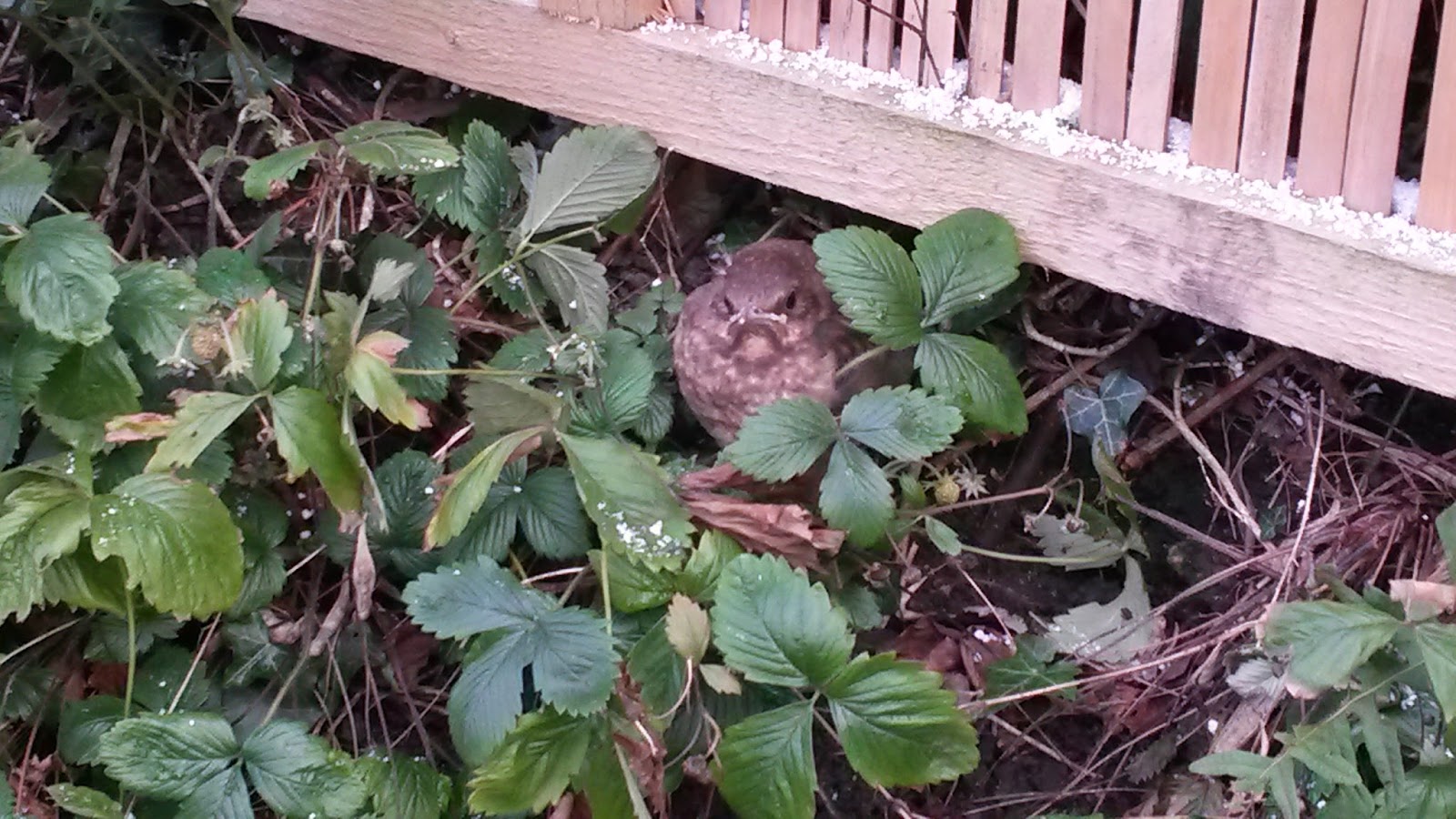
Getting home I found this little fellow in the garden, I put out some extra meal worms and after a trip to the shop came back to the parent birds feeding two almost fully fledged chicks.

Getting home I found this little fellow in the garden, I put out some extra meal worms and after a trip to the shop came back to the parent birds feeding two almost fully fledged chicks.
Friday, 23 February 2018
North Norfolk stroll
On Tuesday 13th I met James and we headed off for a mini tour of North Norfolk, the bird time I've taken the car out any distance to go birding. Our first couple of stops were speculative, calling in first at Sparham Pools hoping for a Goosander. There seems very few around this winter and unsurprisingly there were none here. A large group of Fieldfare were in a nearby field and 3/4 Shoveler the best of the wildfowl on the semi-frozen pools. Going back a few years Manderin used to be seen near Guist, I haven't heard of them here recently but it was on route to North Norfolk so worth a stop. No ducks but I did almost get us stuck while turning around in a gate way.
Near Choesley there was no sign on the previous days Hooded Crow, although James counted 15+ Brown Hare in one field, so we headed onto Titchwell RSPB. By the path to the visitor centre James IDed so fungi while I had a look through the large finch flock, containing mainly Chaffinch and Goldfinch, but a few Brambling, Greenfinch and Siskin were also seen. With high water levels we scooted past the Fresh Marsh and up to the sea. The tide was out so most birds were a little distant, the best birds offshore being Goldeneye, Red-breasted Merganser and Common Scoter. The New Tidal Marsh held a Ringed Plover and quite a few Knot on our way back, but we could not locate the reported Spotted Redshank despite out best efforts. The Meadow Trail did at least turn up a new year bird for me, with at least 4 Red-crested Pochard on the pool past the Fen Hide.
I drove the back roads towards Ringstead slowly in the hope of locating Corn Bunting or other finches but we only came across some commoner birds. Near Ringstead we located part of the Pink-footed Goose flock that has in recent times held a Bean Goose, but it was ease where on this day.
Final stop was Flitcham, and for the first time in ages the Little Owl was actually showing well in the fallen tree. A fellow birder pointed out two freshly hatched Egyptian Geese and a large Starling Flock drifted about. It had started to rain so we had to have an all to short look through the finch flock in the lane, with no sign of hoped for Tree Sparrow we headed back towards Norwich
Near Choesley there was no sign on the previous days Hooded Crow, although James counted 15+ Brown Hare in one field, so we headed onto Titchwell RSPB. By the path to the visitor centre James IDed so fungi while I had a look through the large finch flock, containing mainly Chaffinch and Goldfinch, but a few Brambling, Greenfinch and Siskin were also seen. With high water levels we scooted past the Fresh Marsh and up to the sea. The tide was out so most birds were a little distant, the best birds offshore being Goldeneye, Red-breasted Merganser and Common Scoter. The New Tidal Marsh held a Ringed Plover and quite a few Knot on our way back, but we could not locate the reported Spotted Redshank despite out best efforts. The Meadow Trail did at least turn up a new year bird for me, with at least 4 Red-crested Pochard on the pool past the Fen Hide.
I drove the back roads towards Ringstead slowly in the hope of locating Corn Bunting or other finches but we only came across some commoner birds. Near Ringstead we located part of the Pink-footed Goose flock that has in recent times held a Bean Goose, but it was ease where on this day.
Final stop was Flitcham, and for the first time in ages the Little Owl was actually showing well in the fallen tree. A fellow birder pointed out two freshly hatched Egyptian Geese and a large Starling Flock drifted about. It had started to rain so we had to have an all to short look through the finch flock in the lane, with no sign of hoped for Tree Sparrow we headed back towards Norwich
Monday, 12 February 2018
Happisburgh and Letheringsett
Last Wednesday (7th) after getting the food shopping I headed to Happisburgh with an hour to kill hoping to catch up with the Shorelark that have been present most of the winter, but have eluded me on two previous visits. Walking up to the Lighthouse I had a better view of the whole of the 'lighthouse field' as last time i'd walked the clifftop path. After 10 minutes of scanning I located the Shorelark feeding relatively distantly feeding near the coastal path, typical. 3 Brent Geese were also in the field, 1 Pied Wagtail and a couple of Skylark. Walkiing the clifftop for a closer view the waves pounded the base of the cliff and there was evidence of further small cliff falls that morning. As I got closer to the area the Shorelark had been in a dog walker approached from the direction of Cart Gap and the Shorelark flew past me before landing further inland, close to the Lighthouse but out of view. A quick scan of the sea reveled a few Red-throated Diver, a group of 5 Brent Geese and the expected gulls.


I had a quick look in on Lessingham Church but it was locked, so after a few external photos I headed headed to Stalham. A Marsh Harrier was quartering the field near Ingham, before I picked up some gardening supplies at Wayford. Agnes was having a nap when I got back to mum's so I spent a hour or so digging the allotment. 2 Great Spotted Woodpecker, Long-tailed Tit, Blue Tit and an unexpected Reed Bunting were nearby and a mixed group of Fieldfare and Redwing flew over.
On Thursday Agnes and I had a walk on Walcott seafront collecting stones and flotsam and jetsam from the tide line. The Turnstone's rapid walking reducing Agnes to fits of laughter.
On Thursday Agnes and I had a walk on Walcott seafront collecting stones and flotsam and jetsam from the tide line. The Turnstone's rapid walking reducing Agnes to fits of laughter.
This morning (12th) as Agnes was up and fed early I thought we could have a wander in Holt. Firstly we headed to Letheringsett to see if we could see the long-staying Arctic Redpoll. It was rather quiet when we arrived, but Agnes was happy playing Pooh Sticks on the bridge for a bit, a flock of LTT also came very close and amused her. I heard a Redpoll call and eventually found a small group of Redpoll in the Alders in the field. I soon located the Mealy Redpoll and after a couple of birds arrived from further along the track spotted atleast 1 Arctic Redpoll, however the birds soon moved and Agnes' patience ran out. I felt a bit guilty as I left the birders who had located the Arctic Redpoll for me, with Agnes screaming. Rather than visit Holt we stopped off at Salhouse duck pond and fed the ducks, much more to Agnes' liking. A Marsh Harrier was close by, the Brent Geese and Black Brant could not be seen while driving past Cley East Bank. Stopping at Sheringham for a wander around the shops we saw a Purple Sandpiper on the rocks by The Crown and plenty of gulls but nothing unusual.
Subscribe to:
Posts (Atom)