Friday, 17 October 2014

Finally Birding

Since mid-September a raft of Westerly winds have seen migration in Norfolk slow to a trickle, but just in time for my annual 2 week mid-October holiday the wind shifted. Work meant that I missed trips for the Marked Shrike and Little Crake, but on 8th Oct I did get up to Burnham Norton, in some horrible weather to see the Steppe Grey Shrike, but rather distant.


After work on Sunday Laura and I headed up to North Norfolk to stay with friends but torrential rain on Monday meant there was no chance of a coastal walk. The day got worse as I returned home to find a puddle in our utility room, the roof was leaking! Tuesday was then taken up removing most of the tiles from our extension, repairing and re-tiling the roof. While up on the scaffold c40 Redwing few over and a flock of 22 Long-tailed Tit were in the garden. Wednesday was then spent pulling up the lino and soaked under floor insulation (the only upside was I found a tiled floor underneath). Thursday I managed to finally tidy up and it was only this afternoon that I found time to get out birding.

Being 1pm it was a bit late to head to the coast although a small fall of Pallas Warbler made it was tempting. I plumped for my normal circuit out towards Antingham Pond and back. In the fields I found my first migrants of the day, a flock of 50+ Meadow Pipit, further along another group of 9 flew over. I've only ever seen 2 Meadow Pipit on the walk in the past. Numbers of Blackbird and Song Thrush seem to have increased and a couple of Redwing were seen. Near Antingham Pond while doubling back along the road for a closer look at a group of 3 Buzzard drifting east (one looked very pale) I heard a Yellow-browed Warbler call. Despite waiting around, the tit flock I assume the YBW was associating with moved off without seeing or hearing the bird again. Nearer home a few Jay seemed to be passing over, but not the numbers of a few weeks ago. A few less common migrants have been found along the coast so who knows what the weekend and the rest of my holiday will hold.

Monday, 15 September 2014

A (Half) Marathon Migrant Hunt

I had planned on catching an early train and sea watching at Sheringham and exploring the local area, but waking up to rain I stayed in bed awhile and caught a later train to Cromer. The sea mist was only just burning off so an earlier start would probably have been a waste of time. Although it's not Sheringham I still thought I give sea watching a bash, and did between 8.15am and 9.15am. Gannet made up most of the count with Cormorant going backward and forwards. Here's the full count;

Gannet e79 w16, Manx Shearwater e3, Cormorant e37 w31, Dunlin w2, Great Skua e1, Shoveler e1, Fulmer w2, Sandwich Tern e12, Common Scoter e16 w7, Arctic Skua w1, Teal w4, Kittiwake w2, Wigeon w12.

From the promenade I walked east towards the doctor's steps, seeing 2 Wheatear and a Yellow-legged Gull on the beach. I then had a look around Warren Woods and the area near the lighthouse. Another Wheatear and a few Chiffchaff were all I could muster before walking across the golf course towards Overstrand. The clifftop bushes and cliff slumps look idea for migrants but 2 Whitethroat, 2 Chiffchaff, and a Garden Warbler seemed like a small haul. On the golf cause itself another 5 Wheatear and 1 Whinchat flitted about.


In Overstrand my first hindrines passed over in the form of 2 House Martin and 1 Swallow. A Wheatear was near the car park and another two were on the promenade. Also along the promenade a gentleman rebuilding the beach huts made me aware of a Purple Sandpiper.


Moving onto Sidestrand I found a Yellow-browed Warbler in some sycamores on Tower Road, my best find of the day. Behind the school I found my second Whinchat of the day, before coming across a group of 77 Cormorant resting on the beach. Before reaching Trimingham and the 'clifftop wood' a Tree Pipit flew over, 5 Grey Partridge strangely flew over the cliffs and 2 more Wheatear were in the fields.

Trimming ws my last coastal area before turning inland towards home. The clifftop wood only held a single Chiffchaff and a few tits, near the Pilgrim Shelter I encountered 2 Goldcrest and 5 House Martin flew through. By the sand pit 6 Swallow few around and I saw my 13th Wheatear of the day.

Skirting the edge of Gimingham I saw 2 Buzzard and my final Wheatear of the day. Walking the footpaths via Trunch, Bradfield and Lyngate 3 Chiffchaff, 1 Willow Warbler and a small group of Skylark where probably summer residents rather than migrants. And that concluded my sea watch and migrant hunt, 7.5 hours, 60 species and 22km (half a marathon) later.

Saturday, 13 September 2014

Migrant Hunting Once Again

I started a week off work with an early morning walk on Thursday. Waving Laura off, I set off to walk a regular loop out towards Antingham Pond and back again. It was rather overcast with low cloud and everything seemed subdued, although I did hear a singing Chiffchaff nearby as I left. A Kingfisher whizzing down Lyngate Road as if it were a river, was probably the highlight, but it was just nice to do this walk again as I haven't for a few months. The rest of the day was devoted to jobs around the house.

Friday dad and I headed for the coast in the hope of some migrants. We plumped for Kelling, it seemed as good a place as any and I was hoping the Western Bonelli's may have still been there. Parking by the school we spent a short while looking for the Bonelli's but it was soon evident it had moved on. Walking down the track to the water meadows there were good numbers of Chiffchaff and Willow Warbler, giving us hope for the day ahead. The track also held a good-size flock of Chaffinch and mixed Tits. A single Bullfinch also flew over before I found a skulking warbler, luckily we didn't have to wait to long to see the bird, a Lesser Whitethroat. According to a 'local' the pools have been almost dry and only recently started to fill again, there was enough water though to attract 2 Dunlin, c20 Teal and a similar number of Pied Wagtail. At the beach I decided on a little impromptu sea watch as with binoculars I could see a few Gannet passing through. In 20 minutes we has 30+ Gannet, a handful of Sandwich Tern, 2 Guillemot and a Razorbill. The short turf by the Radar station had a single Wheatear hopping about and on the fence a female Whitchat frustrated me, moving along a post at a time as soon as I focused my camera! A recently ploughed field held good sized flocks of both Skylark and Meadow Pipit, possibly passing through? We soon found ourselves back at the car with few genuine migrants encountered, but nibbling on a few snacks before heading off a Honey Buzzard flew through quite low going east.


A quick walk around Kelling Heath in the vein hope a few of its Heathland specialities remain, proved fruitless with a group of 8 Buzzard the only thing worth reporting, unless your keen on Wren and Woodpigeon. We thought about stopping off at near Sheringham or West Runton, but with little being reported headed home. Checking the days sightings in the evening I learnt of a Wryneck at Beeston!

Before my 8pm physio app the evening still held enough light for a brisk stroll around the Spa Common area. Bird wise unsurprisingly it was rather quiet, but along the roadside I did see quite a bit of fungi and an area of digging that looks quite good for badgers.


Saturday Laura and I spent the day out and about doing various things, which included a brief visit to the cliffs at Paston. A lone Whinchat on the wires by the paddocks and 2 Wigeon on the sea were the total sum of migrants seen. But a ticking bird deep in thick brambles and unwilling to move was obviously something very rare.


Monday, 1 September 2014

Autumn Clifftop Migrants

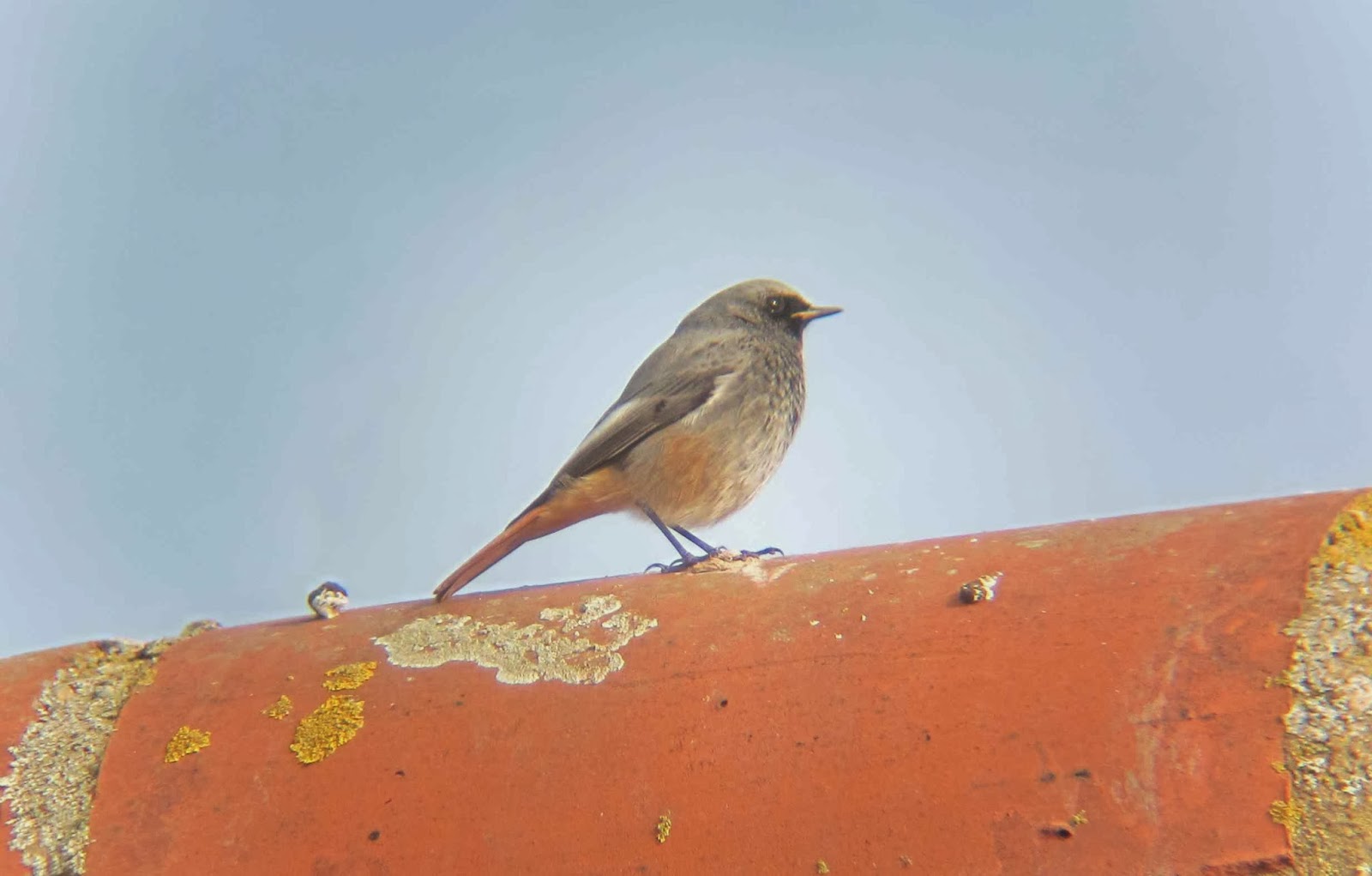
With migrants now really starting to flow I decided to give Paston Cliffs a bash this morning with dad. The scrub by the car park held a couple of Whitethroat and a mixed tit flock buzzed about. It seemed quiet, except for the 75+ House Martin and Swallow hawking around. Scanning the bushes on the cliff face I spotted a rather aggravated Robin, it wasn't happy with something, and I soon managed to spot a lovely looking male Black Redstart at the base of the cliff. In the bracken area the usual Dunnock family flitted about, but diving over the cliff edge another bird caught my eye. Peeking over the edge a top a gorse bush was a female/juv Whinchat. Two new patch birds and I had a third shortly after as I spotted a Pied Flycatcher when if briefly left a scrubby area halfway down the cliff. A few more Whitethroat and a mixed Linnet/Goldfinch flock as I wandered towards the paddocks completed this very pleasant if brief walk.

We did then drive onto Trimingham, but had only reached the clifftop wood when it started to rain quite hard. The rain eventually eased enough for us to make an escape back to the car, but the days birding was over.

Tuesday, 5 August 2014

Migrant Butterflies

With a few days off work but not much going on bird wise, I've spent the last few days generally pottering about. But without trying I have stumbled across a few nice discoveries.

On Friday I went with Dad to his allotment on the edge of town, while feeding the ducks on the 'pond' that is nearby I flushed 3 Green Sandpiper and found a Spotted Flycatcher. This is just within the patch so the latter was also a patch tick. Crossing the road from here to collect some Blackberries the meadow was alive with butterflies, including Small Skipper, Gatekeeper, Peacock, Large White and Small White. But butterfly of the day (well butterflies as there was 2) was Clouded Yellow a species (although a relatively frequent migrant) I have never seen in Norfolk, only on the south coast.


Sunday Laura and I went for a drive, and on our return stopped at garden center near Roughton. In one of their poly-tunnels I was first drawn to a Banded Demoiselle, but that was short lived as I spotted a large butterfly bouncing along inside the roof. The light was poor and the butterfly was mostly silhouetted but something told me to persist. As the butterfly moved along the poly-tunnel I caught a glimpse of the distinctive white edges to the wings, and for a briefest of moments it settled so I could ID it as a Camberwell Beauty, a new butterfly for Britain and my second migrant butterfly in three days. We went onto Pigny's Wood to look for Purple Hairstreak without any luck, but quite a few Darters have emerged and a few Hawker Dragonfly joined them in the air. Lots of Gatekeeper, Meadow Brown, Speckled Wood and Whites where the only butterflies we saw.


Late Monday afternoon as I opened the gates to leave home a Tortoiseshell butterfly flew past and caught my attention as appearing to be slightly large. I briefly followed it around the garden before if flew over the hedge. It looked quite fresh and I'm really not sure if it was 'big' or I was just getting carried away with migrant butterflies, anyway today I'll be checking the garden and buddlia behind the house just in case it was a Scarce Tortoiseshell!

Today (5th) I again spent some time at the allotment, this time armed with my camera and binoculars! I managed an impressive butterfly species count of 15 including 5 Clouded Yellow, a Painted Lady and lots of common species. I spent an age chasing the Clouded yellow around but failed to get a single in focus shot, all the butterflies seemed extra energetic in the baking sun. Down by the 'pond' I found 4 species of dragonfly and 4 species of damselfly including Small Red-eyed Damselfly. The Green Sandpiper was again present, along with a family of Blackcap and Willow Warbler.


Sunday, 20 July 2014

Rare bird or Knot...

....I'm not going to Yarmouth 3 days in a row. On Monday morning news broke that a Great Knot had been found at Breydon Water the night before. Although I was off work it was rather frustrating as I had been in Yarmouth on the Sunday and had already planned a walk around Breydon on Tuesday. The question was do I visit Yarmouth 3 days in a row, with a few jobs to do and the only feasible way to get there involving two trains, I decided to risk it and wait until Tuesday.
My risk paid off, dad dropped me near ASDA at 9.00am before taking mum onto the hospital. By 9.15am I had distant views of the Great Knot which gradually edged closer. By 10.15am the bird had flown in to a distance of c200m, joined the roosting Godwit as the rising tide forced the birds off the mud. By 10.45am I had had my fill of Great Knot and was chomping on a bacon butty in ASDA. The light was poor for photos so I only managed a grainy record shot of the bird among the Godwit, honestly its in there somewhere, a Curlew Sandpiper was also on show.


Gary called me after work on Saturday to ask if i wanted to join him on an evening trip to Winterton with a report that the Northumberland Bridled Tern had the previous night roosted with the Little Tern. A third 'Mega' in Norfolk in less than a week seemed too good to be true (a Black-winged Pratincole was in North Norfolk) and so it turned out. Meeting a group of birders on the beach at Winterton as the sun began to set the stories of the previous day/night unraveled slightly and the now 'probable' Bridled Tern had not roosted but been seen distantly offshore, the presence of a juv. Black Tern in the area also complicated matters. Still on what was a very warm evening (still 22C at 9.45pm) we did get to see a lovely sunset before the thunder and lightning storm we got on our return home.


Monday, 30 June 2014

Late Post, Late Twitch, Late Home

On Sunday 22nd June Gary and I finally got time to go and twitch the Short-toed Eagle, in East Sussex, apologies for the late write up. Gary collected me a little after 2.30am, with a plan to be back in Norfolk for lunch.

We arrived around 6am, already a small cluster of birdwatchers present, allowing us to locate the correct car park at Ashdown Forest. The ST Eagle was yet to rise, but no one was quite sure where in the valley it had roosted, so we spent the next hour or so scanning.


Chiffchaff, Willow Warbler, Bullfinch, Chaffinch, Wren and Pied Wagtail were all around the 'Gills Lap' car park, and scanning the valley we soon had seen Whitethroat, Goldfinch, Stonechat, Blackbird, Great Tit, Mistle Thrush and Swift. There was at least one family of Stonechat and probably a second as we scanned further along the valley. There was no sign of the Eagle, but Woodlark and Tree Pipit proved a pleasant distraction. 

Just after 8.00am news came out that the Short-toed Eagle was perched 2.5km NW of the car park, we thought we should be able to see the bird from where we were so started scanning. Gary picked up a raptor in flight which started off quite a stir, it turned out to be a Honey Buzzard, but a game of Chinese whispers saw people calling it as the eagle! After a second pager message everyone ran off down the hill to try and locate the ST Eagle. We decided to walk in a slightly different direction, after noting a small group of birders across the valley, focused of something. A pleasant chap from Blackpool joined us and soon had some direction from a friend on his phone. We soon located the Short-toed Eagle perch high in a pine, although distant, our position at least gave good light. We moved slightly further up the hill to give us better views if the bird took off, which eventually it did. We couldn't really have left without seeing he Eagle in flight, so although a little latter than planned we left satisfied at 10am.


The traffic around M25 was quite so we cruised home, a quick stop at Stanstead for a drink as it was getting warm and all was well. That was until on the A14 we started to lose power, pulling into services it was clear we had over heated and had little water. After letting the car cool we filled up the water, and it promptly ran straight out of the bottom of the radiator. After a 2.5 hour delay and a visit from the AA we were back on the road, with the hole in the radiator temporarily repaired!

Monday, 9 June 2014

I've been to Specsavers...

...well Gun Hill actually. The Spectacled Warbler turned up last Monday just as a started the stretch of rota that sees me with only Wednesday off, a day I already had plans. So for a week I have read the blogs of friends and wanted to headed to Burnham Overy dunes, but surely the bird wouldn't stay to give me the chance. We luckily for me it did, so today dad and I headed up the coast. We arrived about 10am and didn't have to wait long for the Spectacled Warbler to show. Although it spent much of the time scrabbling through the sueada, on two occasions it perched up singing, before resuming what looked like nest building activities. The bird was always quite close and there was no need to my scope, the below photo was taken on my hand held compact camera.


The warbler had a supporting cast of Little Tern, Spoonbill and a slightly unseasonal Ring Ouzel, alongside the commoner species, before we headed further inland. The birds were harder to come by, with the exception of Common Whitethroat that seemed to be in every hedge. But we saw Tree Sparrow and Montagu's Harrier our target species.

Travelling back toward Kelling we saw a Little Owl sunning itself near Stiffkey, sadly he got camera shy. Two Yellow Wagtail were seen near Warham and a Barn Owl was hunting over the meadows in Cley. Kelling Heath was, with the exception of Linnet rather quite,  and the hoped for Woodlark and Dartford Warbler could not be found. A fly over Turtle Dove excited dad as he hadn't seen one or 3 years, and a family of Stonechat was nice to see.

Since my last blog posting I have on my travels to and from work seen a Red Kite and one of the juvenile Peregrine. Closer to home a Song Thrush has taken up residence in our garden, he has taken to singing from the guttering right out side our bedroom window at 5am and leaves snail shells all over the path.

Thursday, 29 May 2014

Wet Black-headed Bunting & RB Shrike

Yesterday (Wed 27th) Gary called about 7pm offering a lift to look for a female Black-headed Bunting near West Runton. The kitchen was in pieces, as I had removed or the cupboards to decorate but I still went. We arrived in heavy drizzle to hear the bird had been flush and not seen for a while, after waiting for 30min or so the light was very poor, we decided the bird had probably gone to roost so headed home, only to get new that it had reappeared later.

Gary collected me at 4.30am today and we headed to West Runton. I don't think the drizzle had stopped all night, but after an hour of fruitless searching it eased off. And Gary then promptly found the bunting emerging from the garden it probably roosted in. We got good views as it perched on the house roof, and in a briefly in a roadside bush, before it headed off towards the bushes behind the old pig farm. We got reasonable scope views the the light was too poor for me to manage a good photo.

A brief stop at Beeston Bump allowed us to view the always stunning male Red-backed Shrike that is present before returning home by 7am. Writing this I've now dried out and warmed up. The light wasn't much better at Beeston, but I did manage a picture.


Tuesday, 27 May 2014

A possible 'Mega' Norfolk day

We booked the week off and then realised its school half term, so we have decided to stay close to home and try to tidy the house up a bit more. Yesterday in the search of DIY supplies we headed out to Wroxham, going via Tunstead in a bid to avoid a convoy of caravan. It was about 11.30 and close to Wroxham a raptor caught my eye. Circling high it looked strange and I could not pin its ID down, with its wings showing large finger like protrusions and the size of a Buzzard I ended up plumping for a 'strange looking buzzard'. Frustratingly I now learn that a reported Booted Eagle was floating about Norfolk at the time, in hindsight maybe we should have stopped and checked, it may still have been 'strange Buzzard'.

Gary also called to let me know of the Slenderbilled Gull at Titchwell, we had planned to send part of this week in the Holme/Titchwell area before realising that it was school holidays. Another if but and maybe for the day.

Typing this I have just read news of a Black-headed Bunting in Cromer yesterday, with access to be arranged today, if the bird remains. After the night of wind and rain, I can only hope it is drenched and could fly off. Yesterday could have been a Mega Norfolk Day.

On a brighter note our Blue Tit family are about to fledge, and we have at least 6 young Robin and 4 young Blackbird also in the garden.


Thursday, 8 May 2014

Star Wars 'May Bird Race' Day

Leaving North Walsham at 3.30am and collecting James on route, we headed off down the A11, with the Star Wars theme playing loud and Jedi cloaks wrapped around us. It was May ‘four’ce and bird race day! th May and we were on the A11).
(Some of those ‘facts’ might not be true, but it was 4


Our first bird of the day was a female Pheasant (1), on the pavement before we left North Walsham. We had arrived at Santon Downham, before we added a heard only Cuckoo (2). It was -1C and much quieter than normal, so we had to wait a while for things to warm up and the birds to start to call. Walking down to a favoured site for Lesser Spotted Woodpecker, we added Mallard, Water Rail, Blackbird, Kestrel, Wren, Carrion Crow, Woodpigeon, Treecreeper, Blue Tit and Little Grebe (12).
Waiting for any sign of the LSW we heard our first Turtle Dove of the day. Great Tit, Green Woodpecker (H), Mandarin Duck, Nuthatch, Cormorant, Stock Dove, Jackdaw and Lesser Black-backed Gull (20) were added as the morning started to emerge from the frost and misty haze. We then found the best bird for this section of the site a calling Willow Warbler (21), just before deciding to walk back and try St Helen’s Picnic area. On the way we encountered Great Spotted Woodpecker (H), Grey Wagtail, Crossbill, Magpie, Pied Wagtail and Reed Bunting (27)  all before the bridge, and then Starling, Chaffinch, Goldfinch, Moorhen, Robin and Siskin (34). From the road we spotted a group of Crossbill perched up, and closer inspection reviled the flock to be a mix of Crossbill and Lesser Redpoll (35). A quick look by the railway line gave us Long-tailed Tit, Chiffchaff, Bullfinch, Coal Tit (H), Garden Wabler (H) and Blackcap (41). Gary then saw the Garden Warbler but neither James nor I did, amazingly despite trying hard we never saw a Coal Tit all day either. Parking at the  St Helen’s side of Santon Downham, we soon heard and eventually saw Tree Pipt (42).  A walk by the river and wooded area by the church, added Song Thrush, Goldcrest (last year’s boggy bird) and Whitethroat (45). With that we headed off to Lynford a new stop on May’s Bird Race Day.

Within minutes of arriving at Lynford we had clocked a large crossbill flock and as some of them drank in a puddle, we saw the male Two-barred Crossbill (46), joined also by the ‘iffy’ male TBC. We then set of for a lap of the paddock hoping for the reported Wood Warbler and maybe a Hawfinch. We saw neither but added Canada Goose, Greylag, Tufted Duck, Mistle Thrush, Marsh Tit, Yellowhammer, Mute Swan and Swallow (54) to the days total. By the folly a Firecrest (55) was a new  ‘bird race’ bird. Over by the gravel pits Egyptian Goose, Black-headed Gull, Shelduck, Gadwall, Willow Warbler and finally Great Crested Grebe (61), before escaping the wasps in the hide (I counted 6 small and 1 large nest).

We drove on towards Lakenheath, adding Collared Dove and House Sparrow (63) in Weeting village before a brief stop at Weeting Heath NWT. On the reserve we soon saw Skylark,  Stone Curlew, Rook and Lapwing (67).  We watched the Stone Curlew steal a dead mole from a Jackdaw and try to eat it, 6 Mistle Thrush close to the hides were also worth note.

Before arriving at Lakenheath i spotted a Greenfinch (68) the other too missed. Our normal quick dash from Lakenheath RSPB car park, (a dash as not to see birds in Suffolk) up to view the Hockwold washes (Norfolk) from the view point, was detoured via the visitor centre as they have moved the paths. At this point we saw an uncountable Green Woodpecker and cursed. We added Common Tern, Coot, Teal, Shoveler, Grey Heron, House Martin and Hobby (75), the latter bird the highlight if a little distant.

Welney WWT was the next stop on out tour of Norfolk, Red-legged Partridge and Marsh Harrier (77) ticked while on route. In the car park Sedge Warber were singing and a Red Kite (79) drifted over our heads. Scanning Lady Fen Little Egret, Redshank and Avocet (82) found their way onto out lists. We opted to rough it in the non heated hide to the left of the observatory, Whooper Swan, Little Ringed Plover, Wigeon, Common Sandpiper, Oystercatcher, Yellow Wagtail and a distant Sparrowhawk (89) were all noted down. Gary then noted that Great White Egret was in the observations book, the observer was nearby and told us where it had been, and the warden advised to save the walk we may be able to see it from the main observatory. We could so left the hide to walk the walk, no sooner had we left the warden appeared ‘It’s just flow the other way!’. It had landed out of sight but we headed to the Reedbed hide to have a scan. After awhile I located the bird through the reeds, rubbish views but still a tick, Great White Egret (90). Walking back we added Reed Warbler and Linnet (91), before back at the main hide a second Great White Egret was on show. Walking back over the bridge James spotted 3 Swift (93) my first of the year.


In recent years Pentney has turned up some good and often surprising ‘bird race day’ birds, but not today. On route near Downham Market we added Common Buzzard and Feral Pigeon (95). Pentney disappointingly on added Great Black-backed Gull (96) to the lists. Last year Roydon Common ate up a lot of our time as we hunted for Woodlark, again we failed to see Woodlark, but were more conscious of time. Stonechat, Curlew and Wheatear (99) were seen along with a Hairy Hawker Dragonfly. Flitcham continued a little run of disappointing locations, the Little Owl was hiding the no Tree Sparrow could be found, the only bonus was a sleeping Yellow-legged Gull in front of the hide (100).

Stopping in at Choseley it was nice to see the 2 Dotterel (101) that have stuck around for a week and a Grey Partridge was by the barns. The main Titchwell Reserve was our last chance to rack up big numbers of birds before visiting a few sites for more specialist stuff. The pools either side of the main path gave up Red-crested Pochard, ‘Common’ Pochard, Cetti’s Warbler (H) and a Bearded Tit (106). Gary spotted a lone Brent Goose over Thornham Marsh before we viewed a pair of Gargany on the Fresh Marsh. Other new birds on the Fresh Marsh were Black-tailed Godwit, Dunlin, Herring Gull, Grey Plover, Ruff, Arctic Tern and Turnstone (115). James found a Greenshank (116) on the Brackish Marsh, but the previously reported Spotted Redshank, so we headed to the beach. The tide was a long way out but we still saw Little Tern, Sandwich Tern and Bar-tailed Godwit (119), before Gary found our only sea duck, a flock of c20 Common Scoter (120). Walking back to the car Meadow Pipit and Sand Martin (122) were seen. A quick stop at Choseley gave up a Corn Bunting (123), before we headed east along the coast.

Gary spotted a Great Spotted Woodpecker fly over the Coast Road but James and I both missed it. Near Burnham Market a quick stop netted us a Short-eared Owl (124) spotted low over the fields by Gary, who also heard a Lesser Whitethroat. Parking up at Gun Hill we scanned Burnham Overy Dunes and Holkham, Gary picked up 4 Pink-footed Geese and I found 3 Whimbrel and a Spoonbill (127) in the area.

Next stop was Kelling Heath, again no Woodlark, but two Turtle Dove (128) raised our spirits. Cutting back to Cley Marshes NWT we parked at the coastguards and walked towards North Scrape (minus its hide). The Eye field had at least 3 Yellow Wagtail and 6+ Wheatear, but it was scanning to Symonds Scrape that we added Ringed Plover and Common Gull (130) to the tally. The light was fading fast now so we headed up to Salthouse Heath, a single singing Nightingale (131) wasn’t hard to locate, but seeing it was much harder, eventually it gave fleeting views as it flew across the road. Heading home a Tawny Owl (132)  flew across the road near Holt, upgrading our previous heard only bird from Salthouse.


 So we finished the day on 132 species? Well not quite, somewhere in the mix we also saw a Ruddy Duck (133), but in case the environment agency is spying on me I shall not say where. We also found a Stone Curlew deep in the wilds of North Norfolk. 133 was an good total, but we honestly feel 150 is achievable and that was out target. Missing birds like Jay, Barn Owl, Kingfisher, Tree Sparrow, Eider, Knot, Pintail, Little Owl and Woodlark all birds normally encounter we were always going to struggle. I could put it down to the cold start to the day, the heat haze of the afternoon, poor research or just bad luck, but I think I will blame the Sith Lord, coming a day early.

Thursday, 1 May 2014

Putting in the Miles

Tuesday morning I spent helping dad with a few jobs, this did include a trip to Sandy Hills, a small area of the patch to the SE of town. Here I found a Green and Great Spotted Woodpecker, Mistle Thrush and 2 pairs of Shelduck, as well as common tits/finches and Whitethroat which seemed to be everywhere.

After Lunch dad dropped me off near Knapton, I planned to walk to Paston Cliffs and circle back home via Pigny’s Wood. Walking across the fields from Paston at one point 13 Skylark where floating about, and reaching the cliff top I heard the call of a Tree Pipit, it flew west along the cliff top and appeared to land but I never relocated it, but another year and patch tick for ‘the cliffs’. 3 Golden Plover were in the potato field and 4 Turnstone on the beach are worth note. Past the Camp and in the Horse Paddocks I found 2 Wheatear, a Pied Wagtail, 16 Linnet and 5 Skylark all feeding in and around a group of c20 Starling. As the footpath has fallen away I then clambered down the cliff, as I did this 2 Swallow flew through east, has summer been and gone, I know it was a bit chilly but still!

For some reason I then changed my plans thinking a look on the golf course would be good, well it wasn’t a single Wheatear the only bird of note. I then headed off across the fields via the Old Hospital towards Trunch. A skulking Willow Warbler held my attention for a while as heavy drizzle started to fall. The back road hedge held lots of Chaffinch, Tits and Whitethroat, but again nothing to excite. Although I did find a lot of what I believe are Early Purple Orchids (I’m sure someone will correct me if I’m wrong). I then continued my walk via Bradfield and Lyngate to avoid walking the main roads. The weather improved slightly and a few Swallow and House Martin were about the villages. Joining back up with my patch at Lyngate I found what I think was my favourite birds of the day, a pair of Tree Sparrow. I’ve walked this area ever couple of weeks since moving and on two occasions have thought I heard them, but it was nice to finally see them, the 4 Bullfinch that accompanied them in the same hedge were a bonus. It was a nice way to end what turned out to be a 16km walk, but should have been much shorter.


After having to stop putting our fence up, because Blue Tit have moved into one of the old bird boxes I thought I’d have a proper nose about the garden to see what other birds might be nesting. The results for my relatively small garden were surprising, 3 Blackbird, 2 Dunnock, 1 Robin, 1 Great Tit and 1 Blue Tit nests.

Driving home from work last night (Wednesday),  I nearly made Laura crash the car, shouting out ‘Cuckoo’ as we passed through Crostwright, as my first Cuckoo of the year was perched atop of a roadside tree.

Tuesday, 29 April 2014

Birding Along Changing Lines

It’s been 6 months since I moved back to North Walsham, so I thought I’d review my North Walsham patch. The area I decided on as my new patch always felt a bit big, but it contained most of the areas I regularly frequented 10 or so years ago, plus a few new ones.

However now I live on the other side of North Walsham, I have found the areas to the south/east of town (the areas I used to visit most) I have hardly visited at all. Only visiting these areas infrequently I feel I can’t class them as part of my ‘Patch’ and I feel I am better off focusing what free time I have more intensely on the areas closer to our new home.

I have therefore cut down my patch area, removing the Honing area and also the Southrepps/Trunch area which is just that too far to walk from the home. However the ‘lost patch’ areas will still be visited, and I have marked these (in blue) along with a few other sites that a visit but were excluded from my initial patch.

Sunday, 27 April 2014

More Clifftop Migrants

Leaving a Birthday gathering in Mundesley at 6.30pm on Saturday it seemed worth a quick stop off at the Holiday Camp as we were only a couple of minutes away. We initially looked around the horse paddocks to the west, but they failed to give up the hoped for Wagtail or Wheatear, but walking back my first Lesser Whitethroat of the year was in the clifftop brambles. There seemed to be quite a lot of House Martin heading through west with the odd Swallow. Looking over the cliff a group of Linnet flitted about and a couple of Common Whitethroat were defending territories. Back at the car 3 Whimbel flew over, appearing to have flown up from the fields and headed west. Walking the cliffs to the east of the camp a few more Common Whitethroat were about and a single Yellow Wagtail flew over. Driving home not far Pigny's Wood two Wheatear were a surprise, flying along the road in front of the car before perching in the hedge.

Thursday, 24 April 2014

Sounds of Spring

Yesterday while waiting for Laura to have a massage I went for a wander around Spa Common, it was late evening so I wasn't expecting much. By the Mill however I stumbled across the drake Mandarin Duck found last week at Pigny's Wood, not on the patch but still nice to catch up with it. A couple of Song Thrush provided a lovely sound track as the evening became dusk.

I decided today (24th) to head down to Pigny's Wood early, something I've intended but not managed over the last week. Walking along the old railway line, mist hung in the air pierced by the sound of Chiffchaff. Reaching the old bridge at Swafield, I could hear Whitethroat calling, along with Sedge Warbler in the riverside reeds. Among the calls I could hear a Grasshopper Warbler and after 10 minutes or so I managed brief views. Walking along the river a pair of Reed Bunting sang and I found my first Reed Warbler of the year. Before reaching Mike Thurston's a Willow Warbler completed quite a haul of warbers. I had a quick look out from the new hide at Pigny's hoping the Mandarin may have relocated, but only had 2 fly-through Egyptian Geese and a lone Swallow. A female Bullfinch was eating buds nearby and a Great Spotted Woodpecker was near the barn. I wandered up towards the hilltop wood and admired the Bluebells.


 The sound of warblers dominated the morning, by the time I was back in town I had seen no fewer than 8 Chiffchaff, 12 Sedge Warbler, 13 Whitethroat, 2 Blackcap,1 Willow Warbler, 1 Grasshopper Warbler and 1 Reed Warbler. Just two weeks ago I may have heard 1/2 Chiffchaff, what a difference a few days of easterly wind can make.


Monday, 21 April 2014

Clifftop Migrants

After doing a few jobs around the house on Good Friday, Saturday and Sunday saw some free time to go bird watching. (Though on Friday morning at 6.30am I did go out on my bike to look for some reported Dotterel, before Laura awoke, but without success.)

Saturday morning Laura and I popped into Stalham calling at the farmers market and a few local shops. During this time Gary text me, firstly informing me that a Mandarin was at Pigny's Wood, then to tell me it had left and finally to say he had found a Ring Ouzel there. Two good patch birds, and I had planned an early start there too, but tired from spending Friday in the garden, unusually for me I had rolled back over and had a lay in. Feeling I had to make some sort of amends for my faux par, Laura and I called into Mundesley Camp / Paston Cliffs. With a blustery wind I wasn't too hopeful, but shortly after getting out of the car a Ring Ouzel called, before a Yellow Wagtail flew over. Walking towards the Gas Terminal a large flock of c100 hindrines appeared from nowhere, containing mainly Swallow and Sand Martin but with 5/6 House Martin for good measure. I still hadn't located the Ring Ouzel but thought I'd look for Wheatear on the short grass to the west of the Camp, and sure enough I found 2 male and 1 female. Walking back a bird caught my eye darting over the cliff edge, it was a female Ring Ouzel and while looking down towards the beach I notice an Arctic Tern on the Groyne posts. In the clifftop brambles lots of caterpillars had emerged, which I think maybe Yellow-tail or Brown-tail Moth? Getting into the car a further 2 Yellow Wagtail flew over and a Pied Wagtail was in the car park. If I'd have gone to Pigny's I wouldn't have bothered with the cliffs, some you win some you lose.

On Sunday, driving around looking for something to do, Laura and I eventually arrived at Ranworth. A walk down to the floating visitor center, proved to be rather quite but it was nice to see quite a lot of Common Tern wheeling away and starting to prepare to breed on the nest platforms. Arriving home a Coal Tit was a new garden tick, as we pulled into the yard.


Saturday, 12 April 2014

Felbrigg Red-rumped Swallow

At 6.40pm I was sitting on the bus home from work, and nearly at my stop when my phone rang, 2 minutes later Gary had picked me up. A Red-rumped Swallow had been spotted among a mixture of hinderines over Felbrigg Hall Lake and after a quick dash over the meadows we were watching the RRS buzzing about with Swallow and Sand Martin. RRS is a bird that i have chased about on a couple of occasions only to fail to connect.

On the lake I also spotted a pair of Mandarin Duck and together with Sand Martin, Swallow and Red-rumped Swallow, I had added 4 year ticks including 1 lifer. And I was at home again by 7.30pm.

Tuesday, 8 April 2014

Arriving (and Leaving) Mirgants

Walking up to heavy rain i didn't think i would be going far but by 10.30am it was just the odd light shower so i headed out towards Antingham via the Quiet Lanes.

It was rather quiet with many birds no doubt taking cover from the brief but squally showers. By the bridge in Lyngate the trees where a buzz with tits and finches, 2 Chiffchaff made lots of noise and a distant Buzzard circled over towards Swafield. 4 Yellowhammer where near the meadows, but not the Yellow Wagtail that I hopped might be passing through, but i did find some other migrants. 12 Redwing flew over the chapel and then an early Whitethroat and singing Blackcap were in the hedgerow. Antingham Pond was very quiet with all the migrant ducks now gone but a Kingfisher was in the channel that feeds the River Ant. Back near Lyngate 5 Stock Dove were near Grammar School Farm and the drizzle had stopped enough for 3 Skylark to take to the air.


Wednesday, 2 April 2014

Wheatears in the mist. . . not today!

I had to wait in for the boiler repair man until 10.30am so couldn't get out early, and anyway a cold mist hung over everything when i got up. While waiting i dug over a small area of my garden and was followed along by a Robin, a Chiffchaff briefly gave a burst of song from the tree in the garden, the first new garden bird in a while.

Last week i gave my bike a once over, so today pulled it out of the shed. I decided I head out via Felmingham Heath, circle round via the Quiet lanes near Bradfield and head for Mundesley and Paston, hoping the morning mist may have grounded a few migrants. The mist looked like it would soon burn off, but as i got to Felmingham it seemed colder and duller than ever. The Heath held lots of Chiffchaff and i saw 2 Willow Warbler, a calling Blackcap was my first of the year but i could not see it, but that was about it even the tits and finches normally abundant seemed subdued.

Cycling off the Heath i noticed i had a puncture, so headed straight home along Weavers Way my Misty Wheatears would have to wait. On the way back I did stumble upon some migrants though in the form of 22 Fieldfare on the edge of North Walsham. Back at home while putting the bike away (I decided I didn't have the patience to repair the puncture), I scored my second garden bird of the day as a calling Mistle Thrush flew over the garden. I dug a bit more garden, before routing about in the pond trying to clear the pump, in the process I discovered we have Smooth Newts another new specie in the garden.

On Monday I noticed James' Blog reported a Black Redstart nr Bracondale in Norwich, so scurried off during my break to locate it. Initially I thought the bird had gone, but it appeared from over the roof top closely chased by a Blackbird. The Black Redstart briefly took refuge in the trees before returning, sadly I couldn't stay long as I was only meant to be having a 30min break!

Thursday, 27 March 2014

Hitting the Patch

We still have not got a landline installed so have no regular internet access at home, but you have not missed any big adventures with my lack of posts.

Apart from the couple of big away days previously mentioned I've been concentrating on my new patch. Literally starting on my doorstep has allowed me to visit different parts of it on a weekly basis, far more than I could ever manage on the old Whitlingham Patch.

The quiet roads between my house and Antingham have proved to be my favourite area of the patch with 8 visits since Christmas, followed closely by Pigney's Wood. All my patch visits have so far been on foot, including one walk out to the coast at Paston, but with migration starting the bike will now have to be dusted off as I want to visit the Paston area more over the next couple of months.

'Antingham' and 'Pigney's Wood' featured highly during January as both area fell with the 2 miles i set for the 'Foot It Challenge' and i managed a tally of 66 species for January. The Lyngate area to the north of my house forms the core of my 1km sq that i will be focusing on more as plants and insects start to stir with the warmer weather(if the internet is installed next week these pages will soon have a big update).

So far this year the patch has provided 84 species, I've set myself a realistic target of 120 species for the year so we will see how it goes. This years highlights so far include Corn Bunting nr Antingham, Goosander on Antingham Pond and Common Crossbill nr Felmingham Heath.


Tuesday, 18 February 2014

Yellow-rumped Warbler and another trip North

On Saturday, in the teeth of a gale Gary and I headed north to catch up with the Yellow-rumped Warbler in near Durham. Leaving North Walsham just after 4am, dodging a few fallen trees we arrived around 9am.

We didn't have to wait long with great views of the Yellow-rumped Warbler as it done a few circuits of the hedge and nearby gardens. We waited around to try to get better photos as the light was poor but the bird became more reclusive as other birds started to use the feeders.


We headed off to Langdon Beck to hunt for Black Grouse. In places the snow was lying quite deep and drifted across the road in places. Driving through to St John's Chapel we failed to see anything. Surprisingly as it was snowing on the drive back towards Langdon Beck we found 8-10 Red Grouse, and on a pasture close to Langdon Beck Hotel we found 13 Black Grouse. We went off to look at a nearby reservoir, saw nothing and nearly got stuck in the snow. Back by the Hotel I then spotted a Black Grouse in a tree close to the road side, Gary told me i had seen a bin bag or some rubbish, he still reversed and we had crippling views of a male Black Grouse eating berries. The car had not enjoyed the adventure as much as us, with the steering rack caked in ice and the brakes frozen, we had to have a pit stop to defrost the car before heading home.


On Sunday Laura and I headed out to buy a few bits for the house, and while out we saw 2 Common Crane at Potter Heigham, and Whooper and Bewick's Swan at Ludham. On Monday i forgot to look for the Waxwing on Ber Street in Norwich, but writing this i can see the lone Waxwing in the apple tree opposite work. Apologies for another rambling post hopefully i'll get the formatting sorted soon!

Friday, 7 February 2014

A Scottish Dash

Since moving house there has been 3 or 4 'mega' birds to try and twitch, but the move, work and other commitments have left Gary and i concentrating on our local patches. The American Coot has however remained near Inverness since Christmas and although 550 miles away proved one twitch to many to avoid. On Sunday night at 10.30pm Gary picked me up and we started the long drive north. Driving non-stop through the night (stopping only in Avimore, just before we ran out of fuel) we arrived in Inverness at 7.15am, bolted down a fried breakfast in Tescos and arrived at Loch Flemington around 8am. Pulling into the layby next to the Loch within seconds we has seen the American Coot in the margins just feet away. An anti-climax in a way, as 'megas' should not be this easy!


We waited around for the light to improve seeing, 20+ Bewick's Swan, a Great Northern Diver and 6+ Goldeneye. After a trying to tempt the AC closer with a sandwich, we took a few photos and headed off into the Highlands to look for a few Scottish specialties. Driving back towards Avimore via Dulsie Bridge and Lochindorb, we saw Dipper, Peregrine and Red Grouse. At Loch Garten RSPB a man has set up some feeders in the carpark and invited us in close, we saw Coal Tit, Blue Tit, Chaffinch and Treecreeper at extremely close quarters. We then heard the call of a Crested Tit and shortly 3 stunning Crested Tit appeared a few feet in front of us.


Made up we headed off to Cairngorm, our last stop to look for Ptarmigan. Cairngorm Mountain was crazy, the railway and ski lifts were closed but without going higher than the carpark we experienced 90-100mph gusting winds and a wind chill of -12C. Hiding behind the car, we watched c20 Snow Bunting being blown around the carpark, before some how we found a small group of Ptarmigan, distant but still a nice bird to see. Leaving Cairngorm around 1.30pm we arrived home just before midnight to complete our mad dash to Scotland.

Friday, 31 January 2014

January 1st Bird Race

All month I've thought I should really do a post about mine and Gary's annual January 1st Bird Race day. Well the month is not quite out but time has gotten the better of me so below is a summary, shamelessly stolen from Gary of the days birding which despite some horrible weather saw us amass 110 species for the day.

We started the day, leaving the house at 5.30 and heading for Titchwell. The forecast was not good so didn't well hold much hope in a large total.

Arriving at Tichwell, the first visitors as normal, we had already seen Feral Pigeon, Blackbird, Pheasant and Woodpigeon 'in the dark'. We walked along side the freshmarsh as the Sun rose, allowing us to see Greylag, Teal, Canada Goose, Shoveler, Moorhen, Golden Plover, Lapwing, Curlew and Gadwall. The Volunteer Marsh was quiet but on the Tidal Marsh we saw Black-headed Gull, Mallard, Little Grebe, Black-tailed Godwit, Redshank, Grey Plover, Water Rail and Bar-tailed Godwit.


Arriving at the beach it was still very dusk, but was getting light very fast. Along the shore line we could see Oystercatcher, Herring Gull, Turnstone and Common Gull. A Wren briefly distracted us before back to the sea we added Sanderling and Great Black-backed Gull as more birds started to become visible. Gary soon found a cracking little Slavonian Grebe close inshore, a Cormorant and then a few Goldeneye started popping up on the sea. I picked out a small group of Common Scoter and a handful of Red-throated Divers as they started to fly through. We then located some Great Crested Grebes before and a pair of Red-breasted Merganser flew in and landed on the sea. Brent Goose and Eider flew through and then Pink-footed Geese flew past in the distance and a Magpie flew over our heads. Gary spotted a distant Auk which eventually landed and was a Razorbill. Three Long-tailed Ducks then flew through. A Goldfinch flew over before we added to the waders, Dunlin, Ringed Plover and Knot. At this point we saw our first birder of the day, he found some ducks flying over sea and wanted clarification that they were Scoter. Gary then found that the lead bird was in fact a Velvet Scoter. We were about to leave when the same birder shouted Guillemot which gave us a total of 48 before leaving the beach at around 8.30am.

Scanning the tidal marsh and the salt marsh in better light we soon saw Carrion Crow, Little Egret, Wigeon and Pintail. Gary heard and saw a Meadow Pipit drop into the sueda which I didn't see. We saw Shelduck on the Volunteer Marsh before scanning the Fresh Marsh, here we saw Ruff, Avocet, Pied Wagtail and Snipe before carrying on.

Into the bushes we saw Bullfinch, Robin and a showy Cetti's Warbler. We then walked round to Patsy's Pool seeing Marsh Harrier on the way and Pochard, Tufted Duck and Coot on the pool itself. We walked back towards the visitor centre soon adding Blue Tit, Goldcrest, Chaffinch, Long-tailed Tit and Great Tit, with Brambling and Greenfinch in the trees above the feeders. We then went off to get a Bacon Roll and were the first customers of 2014! From the kiosk we added Dunnock, Collared Dove and a Skylark flew over we then left but not before seeing Red-legged Partridge our 76th bird of the day.

Choseley was dead, but not far away a large flock of finches flew across the road, this contained around 50 Linnets, 30 Yellowhammer and a handful of Corn Bunting. Other birds in the flock were around 200 Chaffinch and 30 Brambling. We carried on driving and going through Ringstead we added Jackdaw.

We were heading for Snettisham in the hope of seeing the Black-necked Grebe on the approach road we saw a flock of around 40 Fieldfare and once we arrived at Snettisham car park negative news on the grebe came onto the pager, we checked the first pits anyway adding Egyptian Goose.

On the road we saw a Buzzard near Wolferton before arriving at Flitcham. By this time a persistent light rain was in the air assisted with a terrible wind. At Flitcham we walked from the carpark up the road seeing a handful of Redwing fly over and a Stock Dove on a distant barn. Reed Bunting and Tree Sparrow were in the flock of finches spooked up by a Buzzard along with more Brambling. We then went into the hide seeing Jay in the distance but no Little Owls. A Coal Tit was in the pines as we left the hide to head for Edgefield on 89 species.

On the drive to Edgefield the weather got worst, but we carried on regardless and hoped for the best. During the drive we added Kestrel and Rook near to Sculthorpe.

It was still pouring with rain as we got out of the car at Edgefield. We saw a Song Thrush and were soon watching a 1st Jan lifer a Parrot Crossbill , and a Norfolk Tick for me after missing out on the Bacton Wood birds. Next stop was the tip, we soon added Lesser Black-backed Gull, and continued down the road and found another flock of gulls in which Gary soon picked out the Glaucous Gull.

Still ahead of schedule we decided to add a new destination to the 1st Jan race and set off to Buckenham. A quick call in at the mill at Horstead failed to deliver Grey Wagtail, but we did see a Mute Swan our 96th bird on the river at Coltishall.

Arriving at Buckenham the weather was the worst it had been, standing in the shelter was pointless with the rain being blown straight through it. But it was worth it seeing at first a Starling, then Barnacle Geese, followed by a flock of White-fronted Geese flying over and that landed next to the Taiga Bean Geese. Our 100th bird of the day.

Next stop, Strumpshaw. At the feeders was saw a Marsh Tit and added Grey Heron with a quick to the fen hide. Another quick look at the feeders and a Lesser Redpoll called, followed by very brief views.

The unexpected 104th bird of the day at around 3.15 in near dark miserable conditions right on the peak of the Acle bridge in the middle of the road was a House Sparrow.

A brief stop at Ludham and you could easily pick out the Whooper Swans among the Bewick's. We then carried on to Hickling for the stub mill roost. Upon arrival a Sparrowhawk flew through in front of us. Many Marsh Harriers were flying around and a ringtail Hen Harrier then joined in. I spotted three Cranes in the meadows and we had an additional 11 fly in during the rest of the evening. The last bird of the day and our 110th bird was the same as most years a Woodcock that whizzed past our headed before we wondered back.

Thursday, 30 January 2014

KFC Waxwings

Finger Lickin' Good. News of the near annual return of a small flock of Waxwings behind KFC on Dereham Road meant a detoured to my normal route to work. The four birds present seemed quite flightly circling around and only ever settling for a few minutes at a time. I couldn't stay long and as it was still early and the light poor i didn't even try for any photos. The January 'Foot It' challange is coming to an end, so yesterday (29th) I headed out early to try and add to my total of 63 species clocked up after 3 outings. I headed out towards Pigny's Wood hoping to pick up a owl in the early light. No Owls but a Woodcock along the old railway line, a fligh over Great Black-backed Gull and a Reed Bunting took me over my target of 65 species within a 2 mile radius of the house. 66 species wasn't a bad tally from only 4 outings but it could have been so many more, next year i think i'll aim for 75. Red-legged Partridge, Barn Owl, Pied Wagtail, Green Woodpecker and Kingfisher just 5 species i know should be acheivable.

Thursday, 9 January 2014

Alive and Birding

November was dominated by moving house so going out bird watching was almost impossible. December was not much better, with an excessivly tweeked Christmas rota meaning that most days i left and returned from work in the dark; and those days I did get off I still failed to see the sun as it was obscured by rain. Things are stating to return to normality, on January 1st Gary and I did our regular 'Bird Race' and I have managed to look over atleast part of the new patch in recent days. We still have not got a regular internet connection, but over the next couple of weeks I will post a 'November/December Review' and an update as to the activities of January.

Tuesday, 5 November 2013

Crossbills Don't Like Helicopters!

A bit of a belated update but on the last day of my 'Autumn Migration 2 Weeks Off Work Holiday' (23rd Oct) Gary and myself headed out a little later than earlier in the week and arrived at Lynford Arboretum about 10.30am. As soon as we arrived the flock of Crossbill flew off over our heads, with according to the other birders present at least 1 male Two-barred Crossbill. We contented ourselves looking at fungi, plants and a couple of moths. The birds returned and we got good scope views of the male Two-barred Crossbill, even if it flitted about too much to photograph. The flock was then spooked by military Helicopters flying low over the tree tops, and despite waiting around they did not return quickly so we headed off towards the Titchwell.

Before we arrived news of a Swift sp. at Cley had us hoping to catch up with something exciting on a quiet day of very quiet week on the migrant front. At Cley we soon located the bird over North Hide, but ID was inconclusive, with the bird looking like a Common Swift and then a Pallid Swift as it climbed and fell against the cloudy sky. We intercepted the bird at Salthouse where we got better if brief views, the bird was later confirmed as a Pallid Swift.

While at Salthouse we got new of two reported Parrot Crossbill in Bacton Woods. We spent the next 3 hours hunting around this area of Gary's Patch. We eventually found the Crossbills or rather they found us, as they flew over we could heard the call of a Parrot Crossbill in a small group of 7 Crossbill, but they then perched out of view. The birds feed silently in a tree yards from us only spooked by a helicopter flying over, we failed to relocate them after that and as it was getting late decided to head home. Frustratingly we knew we had seen a Parrot Crossbill but were unsure which one of the 7 it was! Gary later caught up with the birds a couple of days later, confirming a Parrot Crossbill was definitely in the flock.

Monday, 21 October 2013

Semipalmated Plover in Hampshire.

After going to Stiffkey instread of Hampshire on Friday Gary was itching to go look for the Semipalmated Plover on Hayling Island, but with things planned it was not until 4.30am on Sunday 20th that my taxi to the south coast arrived. Driving down the weather was awful with torrential showers, thunder and lightning. After a breakfast stop we arrived at Black Point on Hayling Island around 9am and would have a 3 hour wait until high tide. Slowly the tide pushed he waders off the mud and sand flat forcing them to roost on the beach. Sanderling, Grey Plover, Dunlin and 30 or so Ringed Plover eventually all came close, but despite 100+ birders looking at everyone, no one could call the Semipalmated Plover. Around 11.45 with most birds roosting high on the beach a Carrion Crow spooked everything up and the birds all moved off. We all packed up our scopes and headed half a mile or so along the beach a favoured place for the Ringed Plover to roost at high tide. Here we found c20 Ringed Plover and their slightly smaller cousin, the Semipalmated Plover. The birds had no where else to go with the tide now at its highest and offered great views despite once being cased off by a dog. It turns out the SPP was probably across the bay earlier in the morning at Thorny Island, so the main flock watched for 3 hours hadn't held the bird.


The weather had held out so we decided to try and find the 5 reported Parrot Crossbill along with a Two-barred Crossbill at Hamsted Forest in Kent on the way home. Arriving at the forest we first walked the wrong track before a kind dog walker pointed us in the right direction. On parking at the correct end of the forest, the rain started to fall. We soon found the assembled birders, who very soon left us, as the rain became harder and harder. Hiding under and umbrella but still getting wet, we waited 40 minutes before the rain finally stopped. Almost as soon as the rain stopped we heard the call of a Parrot Crossbill. A few Common Crossbill flitted along the clearing back edge, and among them a male Parrot Crossbill perched up. Although slightly distant the much more chunky beak was clearly visible, compared to the Common Crossbill in the same tree. After enduring the rain we decided to wait a little longer, hoping for better views and possibly the Two-barred to reappear. However by 5.15pm the clouds had started to form again so we headed back to the car, heading home via the Dartford crossing we completed a full lap of the M25 and arrived hope about 9pm.

Final Patch Visit & North Norfolk

On Thursday 17th I decided to visit Whitlingham for what would be my final visit to the Country Park with it still being my 'local' patch. Sadly it proved to be an anti-climax with a distinct lack of wildfowl and very little bird life in general. Fly over Redwing and Fieldfare were two new patch ticks for the year and close views of a Treecreeper the only highlights. I had planned to walk the woods and Whitlingham Marsh, but the lack of activity lead me to the Flint Barn for a warming cup of tea, followed by a slow walk home.

Friday the 18th was a much better day, Gary collected me at about 6.30am and we headed off to North Norfolk (the night before we had debated driving down to see the Semi-palmated Plover in Hants.). We arrived at Stiffkey more hopeful than expecting, as the winds had not been ideal for much migrant movement. Walking towards the Whirly Gig we soon picked up quite a few Redwing, Fieldfare, Song Thrush and Blackbird, also 2 Ring Ouzel but not the numbers of Thrush seen on Monday. With the thrushes was a large mixed flock of Tits and Finches but nothing out of the ordinary. Near to Garden Drove we found a group of 13 Blackcap but they proved to be the only warblers we found in the area. News of 4 Glossy Ibis seen past Wells had us keeping a look out over the salt marsh and eventually they came past, flying on then over Blakeney Harbour and tracked onward East. Small groups of Redpoll flew over most of the morning, along with a couple of Brambling and Crossbill so with at least some evidence of incoming birds we decided to slip and slide out to the bank of gorse out in the salt marsh. Our rewards for this was 2 Rock Pipit and a Water Pipit mixed in with the numerous Meadow Pipit, and a Peregrine hunting over the marsh. The remains of whom's lunch we found in the form of two well stripped Redwing carcasses.


Just back at the car we got news that the elusive Dusky Warbler at Weybourne had been trapped and would be released in 20 minutes, rather than walk the Campsite Woods we raced (always obeying Speed Limits) to Weybourne and arrived shortly before the bird was released at Denmark House. We got brief views in the hand before the bird whizzed off into the bushes.


A brief stop at Cley Spy in Glandford enabled us to view a rather smart male Black Redstart frequenting the barn roofs, before returning home. Driving back Gary was cursing that we had not gone to Hampshire with the Semi-palmated Plover message reporting the bird 'Showing Well', maybe another day!


Monday, 14 October 2013

A Day in the Dunes

The middle 2 weeks of October are always set aside by Gary and myself for a spot of Autumn migrant hunting. Going away this year wasn't really an option, Gary has a new baby and I'm moving house, so Norfolk will be our stomping ground for the next few trips. 

We started today bright and early at Burnham Overy dunes. Walking down the Gun Hill track it seemed rather quiet, maybe this is just because last year we had thousands of thrush streaming in all day, or maybe it was the stiff breeze keeping things low. The first migrant was a Woodcock flushed from the hedge, followed by a few Redwing and Song Thrush. 2 Bullfinch were nice to see, even if not of the trumpeting northern variety. In the sueada by the sea wall we located a few Chiffchaff, Robin and Goldcrest, an early president for the day. A fly over Crossbill with a strange call could of been part of the Parrot Crossbill influx but we will never know. The bushes by the board walk are always productive and today was no exception, singles of Whitethroat, Lesser Whitethoat and Ring Ouzel, along with more Robin and Goldcrest. Walking Gun Hill large numbers of Reed Bunting and Meadow Pipit seemed to dominate along with small flocks of Redwing off the sea. A few Blackcap were by the old brick chimney, and 3 Brambling were near the board walk as we returned. 

Walking towards Holkham we continued to pick up small numbers of thrush, before Gary found a Great Grey Shrike being chased by a large flock of Meadow Pipit. We watched this for a short while before it headed inland with some purpose. In the brambles and bushes by the pines, Robin and Blackcap were about in good numbers, before we stumbled upon a group of c30 Chiffchaff all in a small area. Here we also found our only 2 Fieldfare of the day, 4 Mistle Thrush and 2 Swallow. Walking the southern edge of Holkham Pines we soon stumbled across a Pallas's Warber, more Chiffchaff and Blackcap. Pallas's Warbler are one of my favorite birds and this tiny eartern migrant flitted about at close quarters for a while. From the Cross tracks we headed towards the beach and dunes, seeing 2 further Crossbill and lots of Goldcrest. Things had gone rather quirt so we headed back along the seaward side of the dunes. Nearly back at the boardwalk came news of 2 probable Parrot Crossbill back in the pines! We headed back but after 45 minutes without signed decided to call time on the days birding. Nearly back at the boardwalk again and more news, this time a Siberian Stonechat at Wells. 

Parking in the beach car park and walking back we soon found the location to the West of Beach Road but no sign of the Stonechat. Gary headed back to pick up the car giving me 10 minutes or so to keep scanning, and just as Gary arrived back I found the Siberian Stonechat a little distant, but still showing most of it features and general pale appearance. With a Barn Owl Drifting past in the back ground this was a nice way to finish the day. 

Totals for the day included, c900 Redwing, 58 Song Thrush, 3 Fieldfare, 58 Blackbird, 10 Ring Ouzel, 4 Mistle Thrush,18 Brambling, 3 Crossbill, 125 Meadow Pipit, 64 Reed Bunting, 55 Robin, 56 Chiffchaff, 73 Goldcrest, 1 Whitethroat, 1 Lesser Whitethroat, 58 Blackcap, 2 Swallow, 1 Pallas's Warbler, 1 Woodcock, and 1 Great Grey Shrike.

Sunday, 6 October 2013

Its October, time for some migrants?

On Tuesday 1st, after leaving Mum at the hospital for a day procedure Dad and I headed off to Winterton in search of some October migrants, hopeful brought in by the proceeding few day's easterly winds. Standing in the car park the wind was still brisk and was going to cause problems, any passerines would surely keep low, but on the sea Dad soon picked up 2 Pintail and 7 Brent Geese. With the breeze we decide to walk the south dunes under the Hermanus hoping the bushes would offer some cover. It was evident there had been a recent fall of Robins and there was a passing of c40 Meadow Pipit, but it was surprisingly quiet. 3 Siskin, 2 Willow Warbler, 2 Chiffchaff and a Goldcrest the combine migrant total after nearly 2 hours searching, although we thought we briefly heard a Yellow-browed Warbler.

An impromptu sea watch in the lea of a dune for 30 minutes was much more successful, with 2 Med Gull, 3 Little Gull, 15 Brent Geese, 2 Red-throated Diver, 1 Great Skua, 13 Wigeon and numerous distant Gannet, Kittiwake and Sandwich Tern. Bird of the day however went to a Black-throated Diver heading south.

We briefly looked in the bushes around the totem pole, but the wind was rushing through them so we decided to get some lunch. Walking back to the car we flushed a single Wheatear and 5 Skylark. Back at the car park c50 Common Scoter were close to the beach, but contained nothing rarer. We had planned to look for the Rose-coloured starling at Caister, but mum called and would soon need collecting.

Throughout the dunes we found lots of large hairy caterpillars, which i believe to be Fox Moth caterpillars.


Wednesday, 25 September 2013

A Morning at Strumpshaw and Scouting the Patch

On Tuesday I caught an early bus and soon found myself at Strumpshaw Fen RSPB with the mist still hanging over the reeds. I seemed to be the first person to walk along the Lackford Run as a continual steam of spiders webs stuck to my face. The Lackford Run path was quiet with a few Blue Tit and 2 juv. Reed Warbler on the deck and above me 2 Marsh Harrier were constantly harassed by a large group of Lapwing. From Tower Hide I could see that the winter wildfowl have started to return, 100+ Teal, c30 Wigeon and a large group of Shovler frequented the main pool. The margins were also lively with 31 Snipe, 1 Jack Snipe, 1 Sanderling and 18 Ruff, as well as the for mentioned Lapwing. I had just counted the Snipe and found the Jack Snipe when all hell was let lose, and i soon located the culprit, a female Hobby skimming over the reed bed. I had the hide to myself so spent some time looking through the ducks and waders before heading off along the river bank. The Fen Hide held 6 people but not a single pair of binoculars, just big lenses and cameras pointing at nothing in particular so i soon left. Two Great Spotted Woodpecker sat in the dead by the path back and allowed me to get very close. Grabbing a flapjack from Reception hide I was mid-munch when a Bittern flew past the front of the hide, a few seconds later two of the photographers walked in, hard luck guys. By the feeders i watched a pair of Marsh Tit and a Goldcrest in the Yew tree before heading back towards the main road and bus home.

On Wednesday I needed to be in North Walsham late afternoon, but decided to catch an early bus and scout out a bit of my 'new patch'. Dad dropped me off on Skyton Road after we'd been to the bank and I wandered off to re-discover Felmingham Heath, which I haven't visited in over 10 years. The wet woodland edges to the south and west were full of fungi, which made up for the lack of birds. The main area of dry heath is much patchier than i remember, with large area of gorse, but it was nice to see many areas being re-opened up by habitat management. While watching a group of young Willow Warbler I caught the silhouette of a raptor, initially i thought it was a buzzard, but as it flew closer and into better light i didn't need my binoculars to see it was in fact a Goshawk, a bird i really wasn't expecting. After more fungus hunting i took the back roads and footpaths towards another area of my new patch, the quiet lanes south of Antingham. Although again few birds were about i took my time to re-familiarize myself with lanes, hedgerows and fields, nothing the different habitat, and what i might expect to see in the future. Part of this areas forms the 1km square that i plan to monitor for all species of plant, animal and insect, so i made lots of mental notes of things to look out for next year.


Monday, 23 September 2013

A Quiet September

I haven't really had much to report over the last couple of weeks, with the only local bird of note, the Wilsons Phalorope at Cley appearing and then disappearing while i was working.

On 10th September I did manage a brief sea watch from Walcott, but having to meet the solicitor first it was 10am before dad  and I arrived. We stayed in the car as waves broke on the sea wall, sending spray high into the air. We only scanned the sea for about 30 minutes before a heavy shower reduced visabily and we gave up. But not before spotting a few marine specialists, 4x Sandwich Tern, 1x Arctic Skua, 1x Great Skua, 2x Manx Shearwater, 3x Eider, 2x Common Scoter and 1x Red Throated Diver. I then got thoroughly wet and cold waiting nearly 2 hours for my delayed train home.

I wandered along the River Yare towards the UEA on 20th, but this time on a much cooler day i failed to find any more Willow Emerald Damselfly. With autumn migration not really noticable inland i was concentrating on hunting for fungi rather than the birds, but with a dry summer i failed to find very much.


After a warm afternoon and with a cloudy evening i decided to run the moth trap on 21st, but by midnight the cloud had cleared, and i could get the trap in without the aid of a touch as the moon was full. Unsurprisingly the the trap was nearly empty with only 5 moths in total, the highlight being a Brimstone moth - just because it was yellow!

Monday, 9 September 2013

The Yare Valley and a Willow Emerald

With my planned house purchase starting to gather pace, i decided to spend sometime looking around the areas local to my current Norwich home, it may be the last chance i get to spend some time in the area.

On 30th August i wandered down to Marston Marshes, it was waiting on a call from the estate agents and needed to get out of the house to relieve the tension. Lots of people were out enjoying the sun, but the birds were not. Only 17 species were seen, a rather disappointing total if it were not for a female Redstart found along Marston Lane.

Visting the estate agents in North Walsham gave me the excuse to have a quick wander along the cliff top by Mundesley Holiday Camp on the 2nd September. The wind wasn't great for any migrants coming from the South-west. Two distant Arctic Skua and a few Sandwich Tern were out to sea, as well as the commoner gulls. A Yellow Wagtail flew west along the cliff, a handful of Swallow flew Eastward and a large flock of Linnet were on the nearby stubble field.

A walk along the River Yare from Trowse to Lakeham proved rather fruitless on the 3rd September, 3 young Willow Warbler, a family of 4 Mistle Thrush the probable highlights. I did spend a while however watching a Hornets nest near the electricity substation but didn't have my camera to take any photos.

Whitlingham has been the closest thing i have had to a patch in the city for the last 5/6 years, but i have neglected it of late. Starting at Trowse water meadows i was rewarded with a Kingfisher fishing from a perch, and also a family of Willow Warbler being feed in the river side willows. From Whitlingham Lane 2 Buzzard circled overhead a a Green Woodpecker was in a dead tree. The Little Broad was quiet but a close in Treecreeper was appreciated. On the river my the Water Sports Center a family was 4 Kingfisher were feeding and playing, and 2 Bullfinch flew across the river. The conservation area was rather noisy with lots of juvenile gulls harassing the adult birds. Walking clockwise my attention was caught by a bird flicking about the top of some alders, expecting a warbler i was surprised to see a Spotted Flycatcher. Not far away i found a family of Cetti's Warbler being feed in the scrub,  they looked fully fledged but still begged for food. Scanning Thorpe Station Marsh a lone Lapwing was the only bird i could see. The south show was equally quiet 2 further Kingfisher and a pair of Kestrel over the Meadow the only birds of note as i wandered home.

On Monday 9th September i wandered from Eaton to the UEA following the river year. I continued my trend for seeing Kingfisher everywhere i go with a family group of 3 on the River and another one on the UEA Broad. Other birds of note were 2 Great Spotted Woodpecker and 2 Tawny Owl, the owls called for a couple of minutes before flying alone the woodland edge south of the UEA Broad. It was very strange hearing them call at 10.30am! But the highlight of the day was a probable Willow Damselfly found by the river. (i say probable because my damselfly ID isn't the best, so if some one could confirm the ID i would be grateful.) As far as i am aware this would be a new site for the species that seems to be spreading in East Anglia.